

Deep-Sea Lizardfish: The Ambush Hunter Below
A patient predator filmed more than two kilometres down.
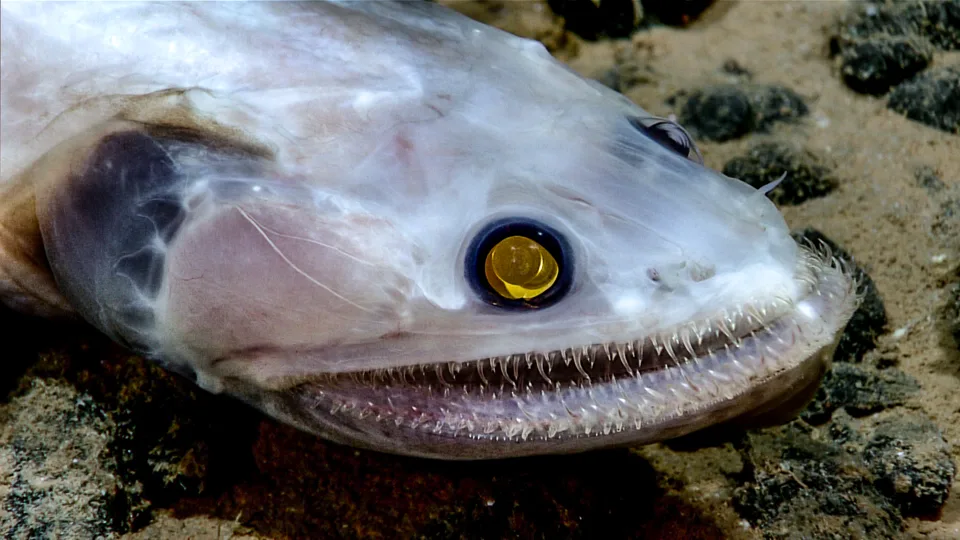
On the deep seafloor, a predator may remain motionless until a passing animal comes within range. Deep-sea lizardfishes in the genus Bathysaurus are built for that kind of existence, with elongated bodies, large mouths and conspicuous teeth.
Unlike the luminous anglerfish of the open water, these animals inhabit the seabed, where their behavior must be understood against sediments, rocky slopes and the sparse traffic of other creatures. Their appearance evokes a prehistoric reptile, but the resemblance is superficial: they are modern ray-finned fishes.
NOAA Ocean Exploration released video of a deep-sea lizardfish observed at about 2,358 metres during its 2023 Shakedown + EXPRESS West Coast Exploration expedition near Trinidad Slump. Actual research footage is far more useful than exaggerated online descriptions of “living dinosaurs.”
The animal’s jaws and positioning suggest how a patient hunter could exploit occasional opportunities in a food-limited environment. Still, a short video cannot establish every aspect of its diet or hunting behavior.
This final story brings the series back to its central question: how much life remains poorly observed below the reach of ordinary divers? The creatures are real, the footage exists, and the unanswered science is compelling enough without embellishment.
Sources
- Scientific source: NOAA Ocean Exploration: Bathysaurus spp.
- Further reading: NOAA Ocean Exploration
- Cover photo: The teeth of a deep-sea lizardfish (family Bathysauridae) at 4,855 metres, Beyond the Blue: Papahānaumokuākea, 2025. A different animal from the one in the video. Credit: NOAA Ocean Exploration, 2025 Beyond the Blue (public domain).
Photographs and uploaded video: NOAA Ocean Exploration and partner expeditions, public domain, credited in each caption. No AI-generated animals are used in this series.
Comments (0)
Log in to comment