

Dragonfish: The Predator That Carries Its Own Light
Bioluminescence turns darkness into an advantage.
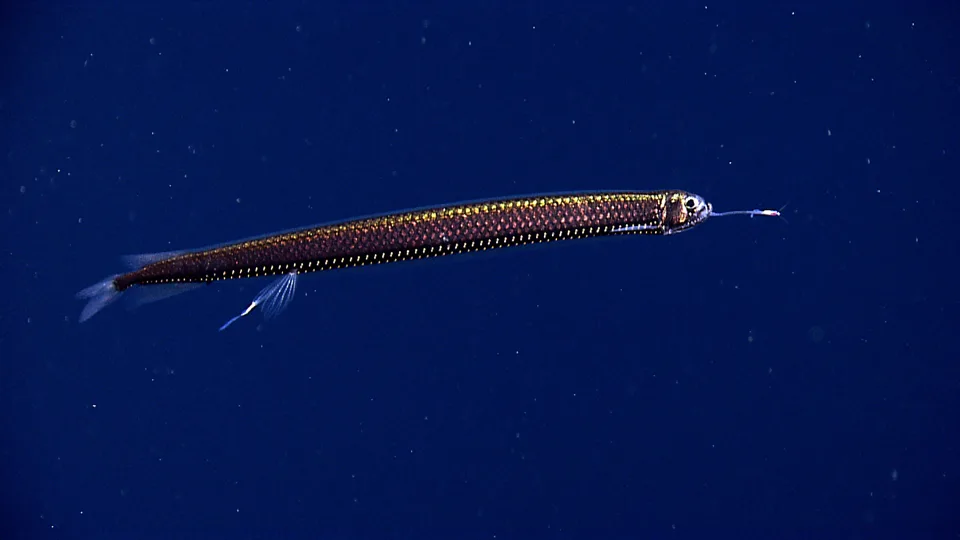
A dragonfish looks built for a nightmare: elongated jaws, needlelike teeth and, in many species, light-producing organs. Yet these features have practical uses in a habitat defined by darkness. Bioluminescence may help deep-sea animals lure prey, communicate or avoid being detected.
MBARI’s deep-sea observations include the Pacific blackdragon, Idiacanthus antrostomus, and the longfin dragonfish, Tactostoma macropus. They belong to a diverse assemblage of predatory fishes, not a single uniformly behaving species.
Some dragonfishes have specialized visual and light-producing adaptations that let them exploit wavelengths or light levels other animals may not easily detect. Others use rows of photophores along the body. Such variations make the family scientifically compelling: there is no one-size-fits-all answer to surviving the midnight zone.
When watching the researchers’ footage, focus on the shape of the jaws and the distribution of luminous structures. Those details tell a story about feeding and camouflage, not fantasy.
The unanswered questions are just as fascinating: how frequently do these fish hunt, what do they pursue, and how do they recognize potential mates across a vast dark ocean? Each robotic dive contributes another fragment of the answer.
Watch the real footage
Sources
- Scientific source: MBARI: Idiacanthus antrostomus and other dragonfishes
- Further reading: MBARI
- Cover photo: A dragonfish in open water, photographed by the ROV Deep Discoverer during the 2014 Our Deepwater Backyard expedition to the Atlantic canyons and seamounts. Credit: NOAA Okeanos Explorer Program (public domain).
Photographs and uploaded video: NOAA Ocean Exploration and partner expeditions, public domain, credited in each caption. Embedded videos stay on their owners' YouTube channels. No AI-generated animals are used in this series.
Comments (0)
Log in to comment