

Fangtooth: The Small Fish With Enormous Teeth
A terrifying close-up, a surprisingly small animal.
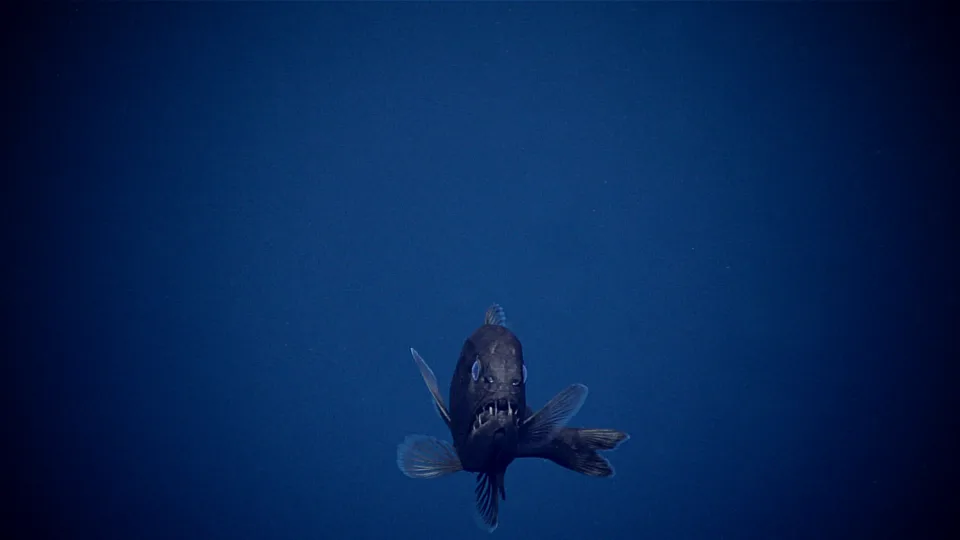
Some creatures seem larger in photographs than they truly are. The fangtooth is one of them. Its outsized teeth and heavily built head create a fearsome close-up, but the fish itself is relatively small. Its teeth are remarkable in proportion to its body.
Fangtooths live in the deep ocean and use their prominent teeth to seize prey in an environment where feeding opportunities are uncertain. The dramatic mouth is not evidence of an undiscovered giant predator. It is an example of how selection can exaggerate one useful feature.
NOAA Ocean Exploration photographed a fangtooth investigating the remotely operated vehicle Deep Discoverer at roughly 800 metres during a 2017 expedition. That encounter gives the public a rare chance to see the real animal rather than an illustration.
The ocean contains many fishes with large jaws, expandable stomachs and striking teeth. Such designs appear repeatedly because the underlying survival problem is similar: an unpredictable supply of food.
What makes the fangtooth mysterious is not its supposed menace to people. It is the difficulty of observing its everyday life. Most of its world remains out of reach of ordinary cameras, leaving biologists to reconstruct behavior from occasional encounters and collected specimens.
Sources
- Scientific source: NOAA Ocean Exploration: Anoplogaster spp.
- Cover photo: A fangtooth (Anoplogaster) “considering what Deep Discoverer was doing”, Musicians Seamounts, 2017. Credit: NOAA Office of Ocean Exploration and Research, Deep-Sea Symphony: Exploring the Musicians Seamounts (public domain).
Photographs and uploaded video: NOAA Ocean Exploration and partner expeditions, public domain, credited in each caption. No AI-generated animals are used in this series.
Comments (0)
Log in to comment