
The Fish With a Transparent Head
A living window into an unseen world.
Imagine looking through your own forehead to find dinner. For the barreleye fish, that is remarkably close to reality. Macropinna microstoma lives in the dim midwater, with tubular green eyes enclosed within a transparent, fluid-filled shield. Those eyes can point upward to detect silhouettes and faint light, then rotate forward when the fish feeds.
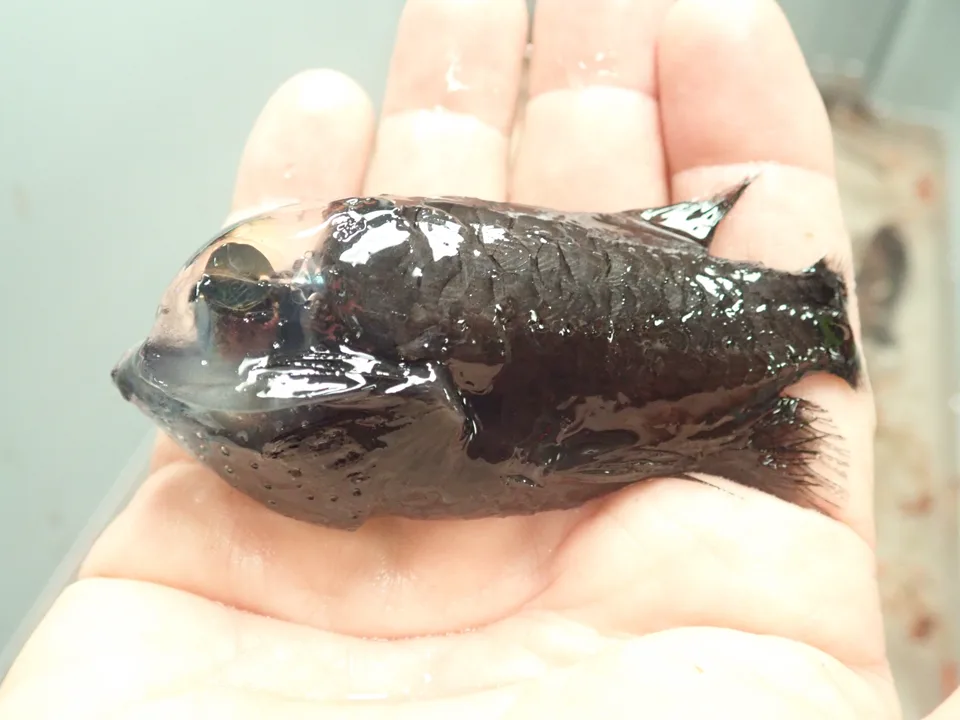
The striking dome is not a science-fiction invention: remotely operated vehicles have filmed it in the ocean. Earlier descriptions of preserved specimens missed some of this extraordinary anatomy, because the delicate shield can be damaged when fish are collected.
Researchers at MBARI combined footage and observations to understand how this small fish sees and eats. The apparent “eyes” at the front of its face are actually olfactory organs. Its true eyes are the green structures visible inside the head.
The mystery is not whether the animal exists. It is how many similarly specialized creatures still pass unseen through the planet’s largest habitat. A recent MBARI encounter captured fresh 4K footage and made the barreleye an ideal opening story for this series.
Watch the real footage
Sources
- Scientific source: MBARI: Macropinna microstoma
- Further reading: MBARI
- Cover photo: A barreleye of the family Opisthoproctidae, brought up in a trawl during an exploration of the Gulf of Alaska seamounts. NOAA does not name the species. Specimens like this lose the delicate transparent shield, which is why live footage matters. Credit: Exploring Pelagic Biodiversity of the Gulf of Alaska and the Impact of Its Seamounts, via NOAA Ocean Exploration (public domain).
Photographs and uploaded video: NOAA Ocean Exploration and partner expeditions, public domain, credited in each caption. Embedded videos stay on their owners' YouTube channels. No AI-generated animals are used in this series.
Comments (0)
Log in to comment