
The Gulper Eel: The Deep Sea’s Impossible Mouth
A mouth engineered for the scarcity of the abyss.
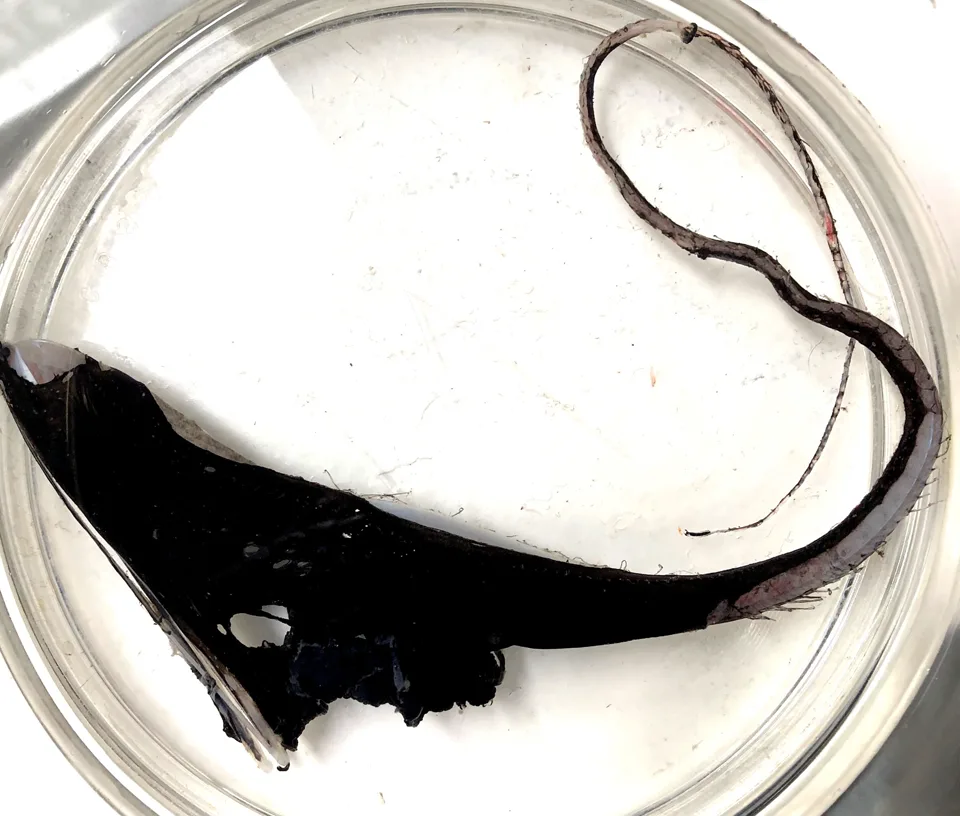
At first glance, a gulper eel appears to be mostly mouth and tail. Its jaws can open remarkably wide relative to its narrow body, an extraordinary adaptation for feeding when encounters with prey are unpredictable.
Despite the common name, these are specialized deep-sea fishes rather than typical shallow-water eels. MBARI has documented gulper eels living in midwater from hundreds to thousands of metres below the surface. Their flexible bodies and unusual jaws can seem almost unreal on underwater video.
Popular captions sometimes claim the eel routinely swallows animals far larger than itself. The safer scientific conclusion is that its enormous mouth helps it capture scarce prey of different sizes. What it eats, and how it hunts in the wild, are active subjects of observation.
The species in MBARI’s whiptail gulper eel profile, Saccopharynx lavenbergi, shows how much adaptation can emerge from a simple ecological problem: food is hard to find in the open deep ocean.
The most memorable images are not computer-generated monsters. They are real frames recorded by research vehicles. The creature’s bizarre outline is a reminder that evolution does not need to satisfy our expectations of what a fish should look like.
Watch the real footage
MBARI has filmed this animal alive in the deep sea. The footage is published on MBARI's own site.
Watch MBARI's gulper eel footage
Sources
- Scientific source: MBARI: Saccopharynx spp.
- Cover photo: A pelican eel (Eurypharynx pelecanoides), another gulper eel, recovered damaged from the outside of a trawl net in 2019. Its enormous jaw is folded against the body. Credit: Journey into Midnight: Light and Life Below the Twilight Zone, via NOAA Ocean Exploration (public domain).
Photographs and uploaded video: NOAA Ocean Exploration and partner expeditions, public domain, credited in each caption. No AI-generated animals are used in this series.
Comments (0)
Log in to comment