

1948 — Montgomery, Alabama: the airliner pilots and the “two rows of windows”
Before dawn on 24 July 1948 two Eastern Air Lines pilots saw a wingless, flaming object pass their DC-3. The US Air Force file keeps their statements and sketches, an intelligence report that left it unidentified, and the astronomer’s note that pointed to a meteor.
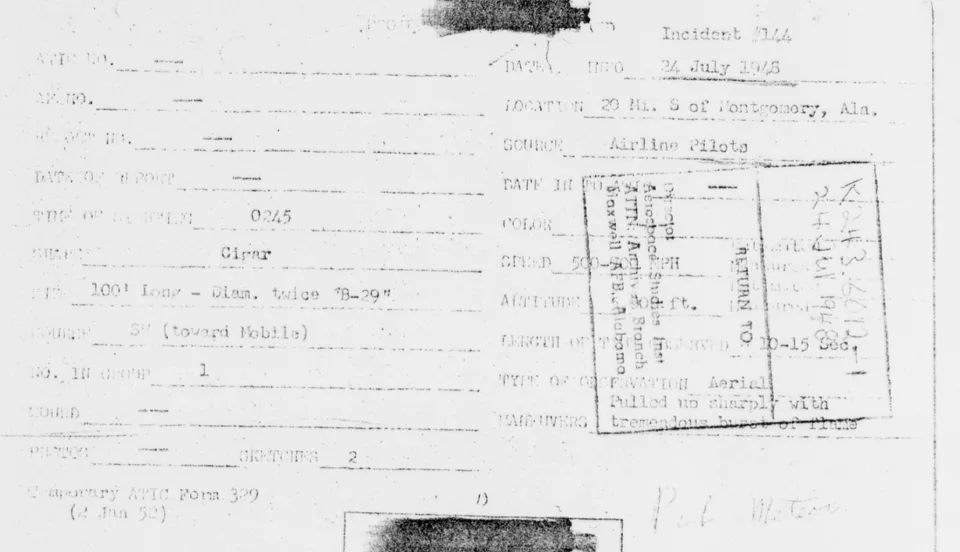
At a glance
- Document: Project Blue Book case file “20 Mi. S of Montgomery, Ala., July 1948 – Incident Number: 144”
- Contents: statements of Captain Clarence S. Chiles and his co-pilot, their sketches, an Air Intelligence Information Report, astronomical analysis, later correspondence
- Event: 24 July 1948, 2.45 a.m. Eastern time, Eastern Air Lines trip 576, Houston to Atlanta
- Length: 161 scanned pages
- Where it is today: US National Archives, Record Group 341, microfilm T1206, NAID 28931059
The captain’s report
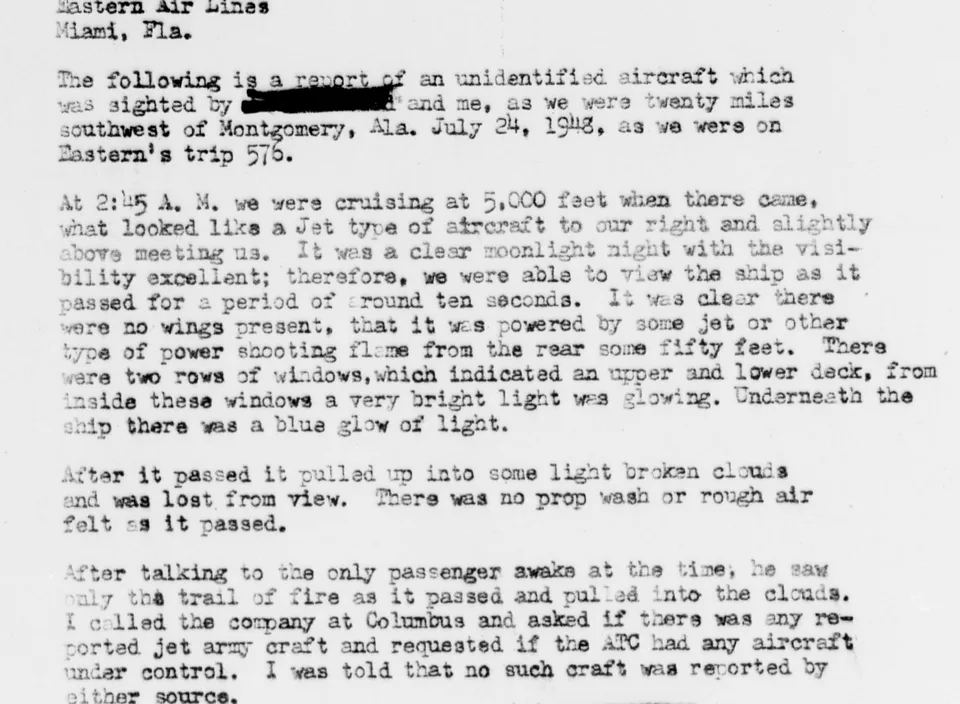
Writing to his airline on 3 August 1948, Captain Chiles described a craft that came towards them “to our right and slightly above” at 5,000 feet, in clear moonlight, for about ten seconds:
“There were two rows of windows, which indicated an upper and lower deck, from inside these windows a very bright light was glowing.”
He saw no wings, a flame some fifty feet long from the rear and a blue glow underneath. It pulled up into broken cloud. No other aircraft was reported in the area.
The co-pilot’s report
The co-pilot, Whitted, gave his own written account. He first assumed it was an Army or Navy jet, “but as it came nearer I could see that it was much larger”. His estimates: about 100 feet long, half a mile away, roughly 700 mph — “purely a rough estimate” — seen for five to ten seconds. He also described large, square, lit windows.
Both men drew what they saw. The sketches are filed as Exhibit “A”.
Intelligence: “unidentified”
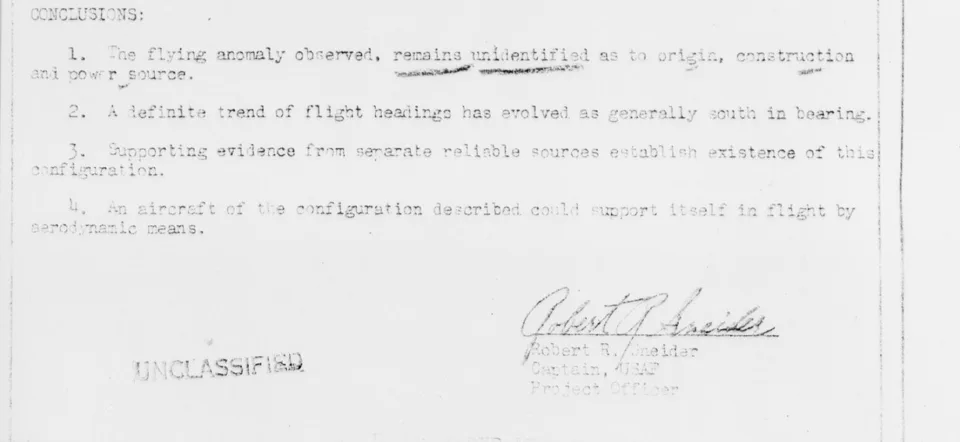
An Air Intelligence Information Report signed by Captain Robert R. Sneider, project officer, studied whether such a wingless shape could fly. Its first conclusion:
“The flying anomaly observed, remains unidentified as to origin, construction and power source.”
A memo of 7 December 1948 shows that a draft conclusion about “space ships” had been criticised as not based on the report, and replaced with the neutral wording kept in the final version.
The astronomer: a meteor?
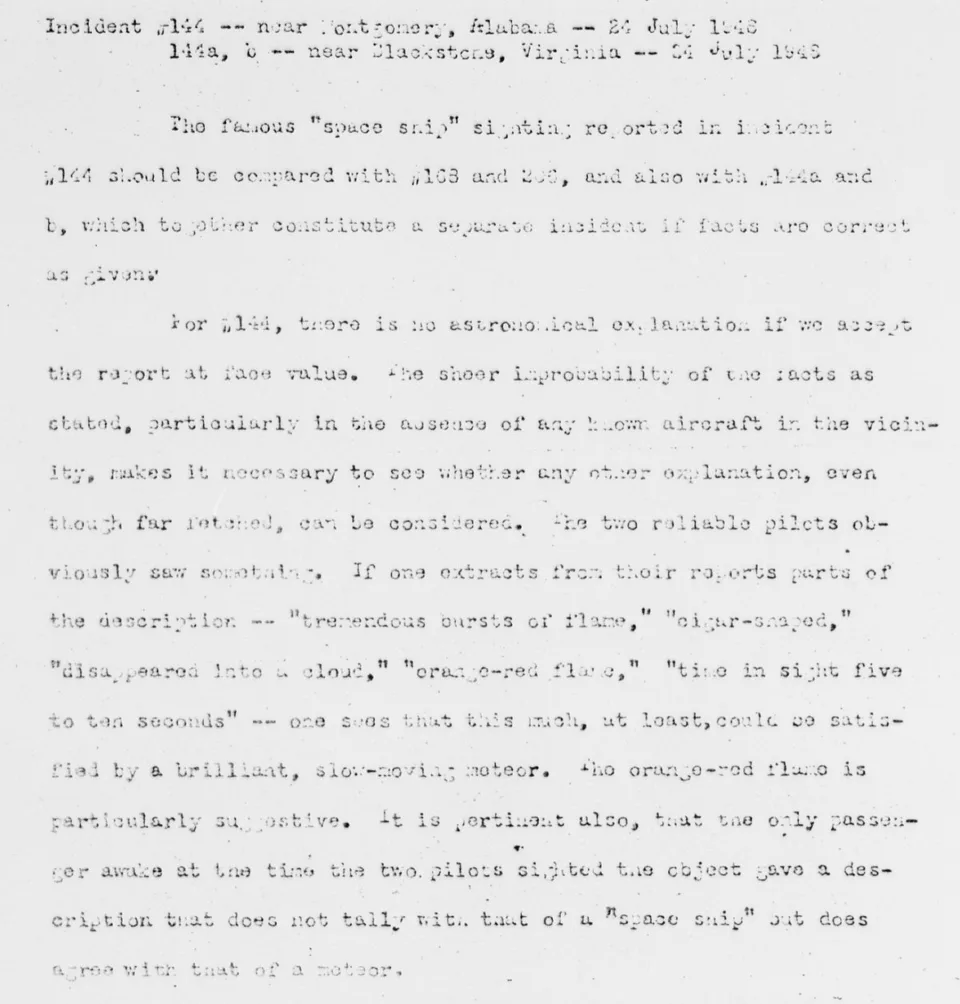
An unsigned astronomical review in the file states that taken at face value there was no astronomical explanation, but that parts of the description — flame, cigar shape, a few seconds in sight — could fit “a brilliant, slow-moving meteor”. It noted that the only passenger awake saw just a trail of fire. Whether a meteor could look like lit windows it left “to the psychologists”.
The file’s final label, typed on a separate sheet: “Probable Astro (METEOR)”.
What it does not say
- The pilots did not claim a spaceship. Chiles wrote of an “unidentified aircraft”; by the co-pilot’s account he radioed that it looked like “some type of rocket ship”.
- “Space ship” appears in the file only in Air Force paperwork, and the draft conclusion using it was removed.
- The meteor verdict is labelled “probable”, and the analysis behind it admits it does not explain the windows.
- The two accounts differ in detail: about ten seconds or five to ten; twenty or twenty-five miles south-west of Montgomery.
Why it matters
Two experienced airline pilots, a clear night and a sighting of seconds: the case shows how hard early investigators found it to weigh honest witnesses against physics, and how close one report came to carrying an official “space ships” conclusion.
Sources
US National Archives, Records of the US Air Force (RG 341), “Sanitized Version of Project Blue Book Case Files on Sightings of Unidentified Flying Objects”, file unit “20 Mi. S of Montgomery, Ala., July 1948 – Incident Number: 144”, NAID 28931059, microfilm T1206. US government records, public domain; the catalogue marks the file unrestricted.
Comments (0)
Log in to comment