
1950–1952 — Great Falls and Tremonton: two films, three official verdicts
Two short colour films of bright dots in a daytime sky became the best-known “UFO movies” of the 1950s. The Air Force files and a CIA report show what the analysts actually concluded: a US Navy laboratory called the Utah objects light sources that were not birds, balloons or aircraft; a CIA-convened panel refused to accept that; the Air Force settled on aircraft reflections and seagulls.
At a glance
- Documents: two Project Blue Book case files; US Naval Photographic Interpretation Center progress reports (5 December 1952 and 4 May 1953); CIA “Report of Meetings of Scientific Advisory Panel on Unidentified Flying Objects”, 14–18 January 1953; Air Force memorandum “UFO Movie”, 1 June 1956
- Events: Great Falls, Montana, 15 August 1950; near Tremonton, Utah, 2 July 1952
- Marking: originally Confidential or Secret, now declassified
- Where they are today: US National Archives, Record Group 341 (NAID 28938188 and 28943418); CIA Reading Room, CIA-RDP81R00560R000100030027-0
Great Falls, 15 August 1950
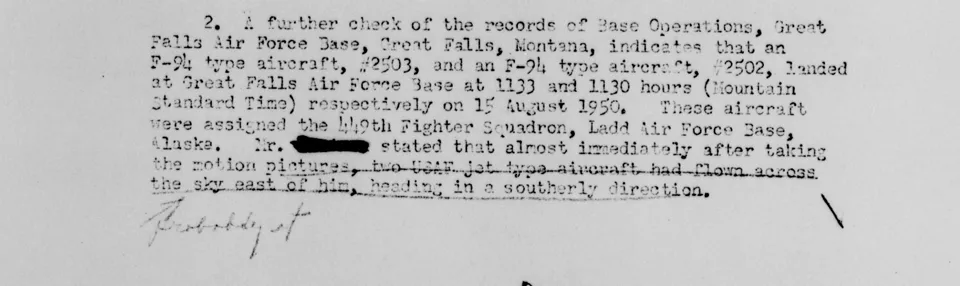
An Air Force special investigations report of 6 October 1950 gives the account of the general manager of the Great Falls baseball club. Between 11:25 and 11:30 a.m., from the grandstand of the ball park, he saw “two bright disc shaped objects”, ran to his car for his 16 mm Revere camera and filmed them on Kodachrome at sixteen frames a second. His secretary was also a witness. About fifteen feet of film went to the Air Force.
The same investigators checked the base records. Two F-94 jets had landed at Great Falls Air Force Base at 11:30 and 11:33.
Tremonton, 2 July 1952
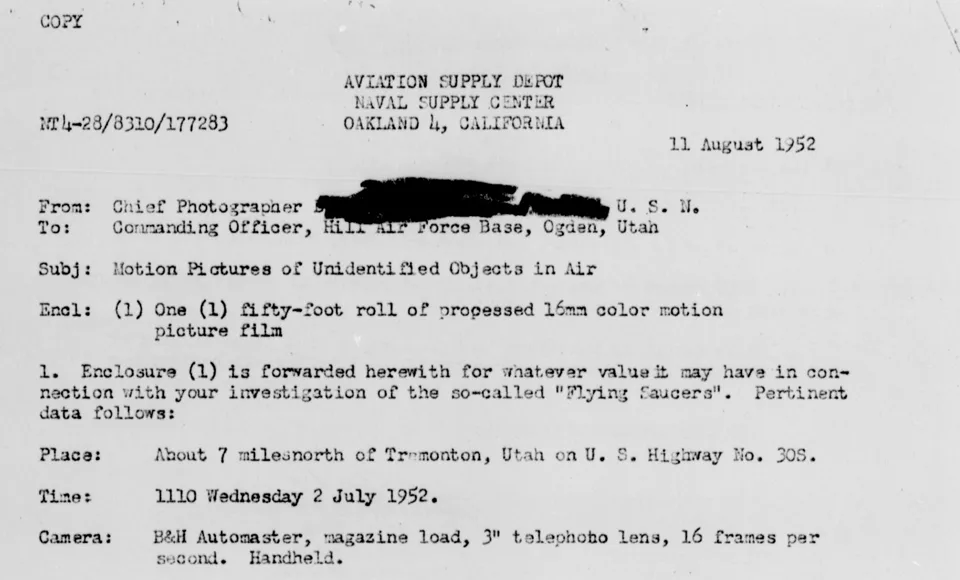
The second film came from a Navy chief photographer driving across Utah with his wife. On 11 August 1952 he sent a fifty-foot roll to Hill Air Force Base with a short covering letter: about 7 miles north of Tremonton, at 11:10, he had exposed some thirty feet of film with a hand-held camera and a 3-inch telephoto lens.
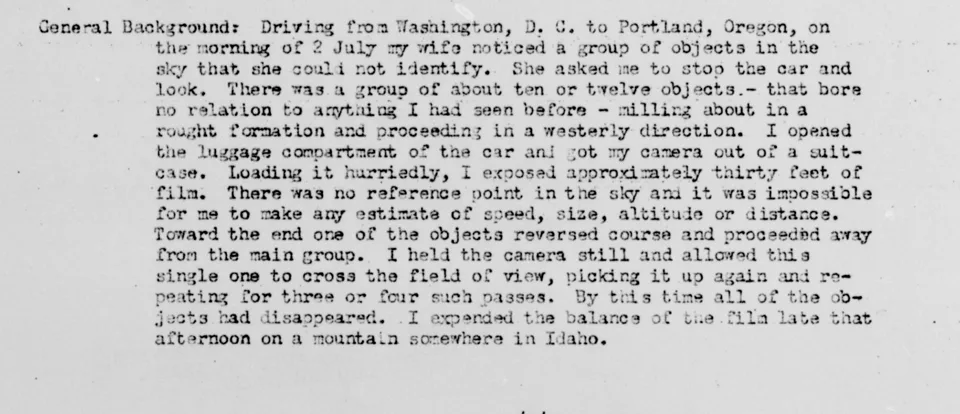
“There was a group of about ten or twelve objects – that bore no relation to anything I had seen before – milling about in a rought formation…”
He added that, with no reference point in the sky, he could not estimate speed, size, altitude or distance.
The Navy laboratory: “a light source”
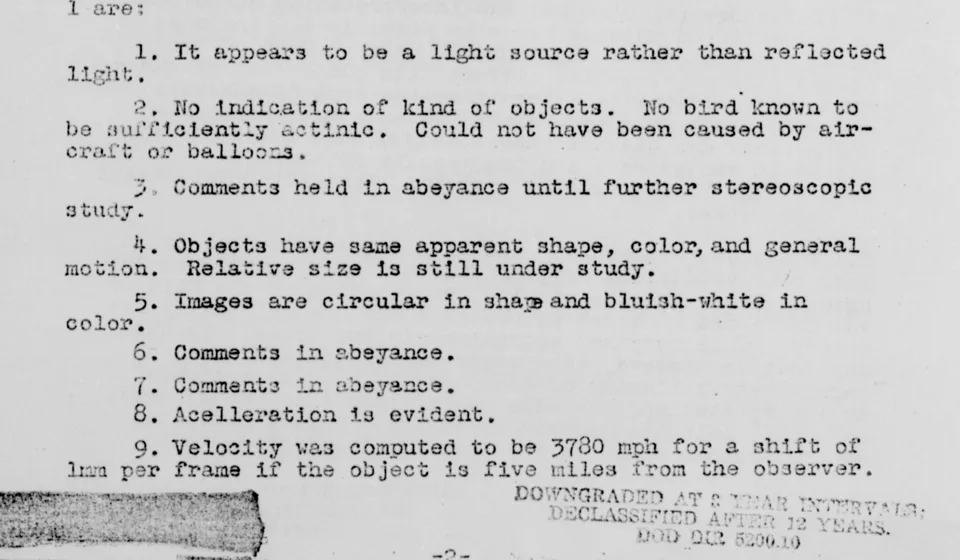
The Air Force passed both films to the US Naval Photographic Interpretation Center in Washington. Its progress report of 5 December 1952 answered the Air Force's list of questions on the Utah film point by point:
- “It appears to be a light source rather than reflected light.”
- “No bird known to be sufficiently actinic. Could not have been caused by aircraft or balloons.”
- a velocity of 3,780 mph for a shift of 1 mm per frame — if the object was five miles from the camera.
The follow-up report of 4 May 1953 states that the results “do not necessarily represent the official attitude” of the Navy Department or of the Center.
The CIA panel: not accepted
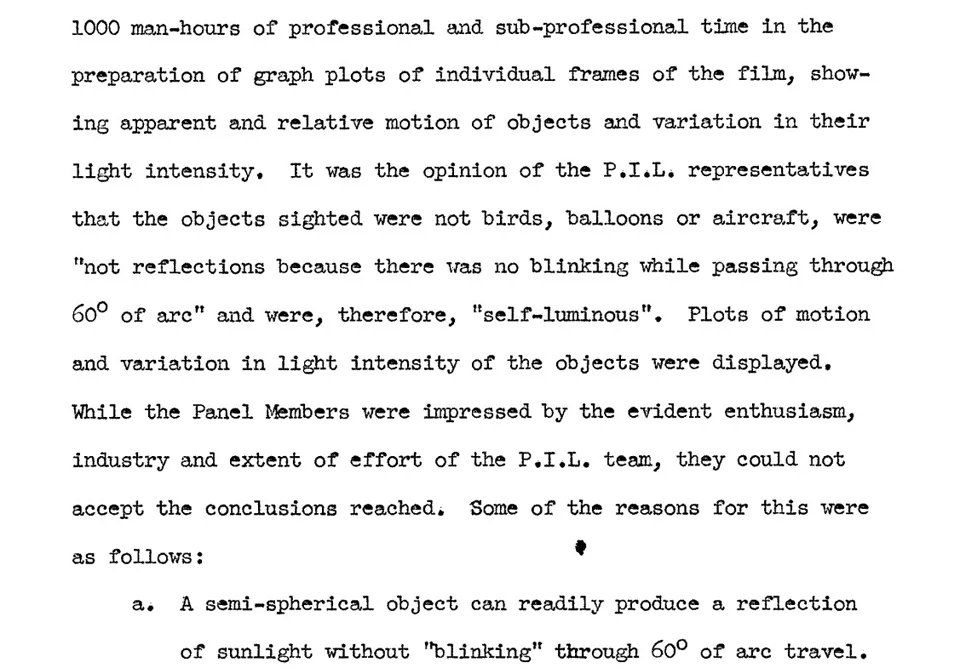
In January 1953 the scientific panel convened by the CIA watched both films and heard the Navy analysts, who had spent about 1,000 man-hours on the work. The report of the meetings records the outcome:
“…they could not accept the conclusions reached.”
Among the panel's reasons: a semi-spherical object can reflect sunlight through 60° of arc without “blinking”; the motions, sizes and brightness of the Utah objects were “considered strongly to suggest birds”, the more so after a film of seagulls in bright sunlight was shown; the light measurements had been made on a duplicate, not the original. The Great Falls objects were “strongly suspected of being reflections of aircraft known to have been in the area”.
The Air Force's last word
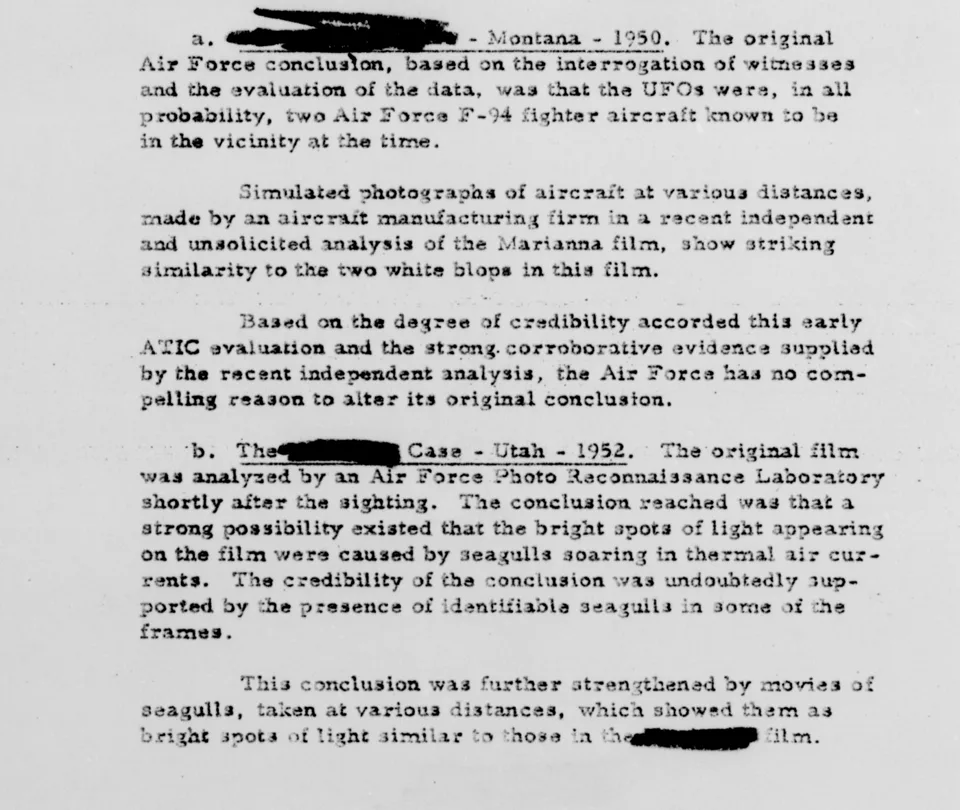
The Great Falls verdict changed over time. An Air Force letter of 16 May 1952, signed by Colonel Frank L. Dunn, gives the probable cause as “Unknown” and lists light reflections on two jet aircraft among the causes considered. By 1 June 1956, in a memorandum written for the Pentagon press room after a newly released movie had described both sightings, the answer was firm: the Montana objects were “in all probability, two Air Force F-94 fighter aircraft”, and for Utah there was “little reasonable doubt” that the objects “were indeed seagulls”.
What it does not say
- The Navy did not certify “craft”. Its laboratory reported unidentified light sources, gave a speed only under an assumed distance, and said the work was not the Navy's official view. The December 1952 report lists no conclusions.
- The CIA panel did not prove birds. It found birds strongly suggested and named further tests — balloons, ornithologists — that it judged not worth the cost for every case.
- Great Falls was not always “explained”. In 1952 the Air Force itself wrote “Unknown”.
- No size or distance was ever measured for either film.
Why it matters
The same few feet of film produced three readings from three official bodies. The files show how much depended on one unknown — distance — and how a tentative laboratory finding, a sceptical panel and a press-room memorandum can each be quoted as “the official conclusion”.
Sources
US National Archives, Record Group 341, Project Blue Book case files, NAID 28938188 (Great Falls) and NAID 28943418 (Tremonton), catalogued as unrestricted. CIA Reading Room, document CIA-RDP81R00560R000100030027-0, approved for release 2001. US government works, public domain. The films themselves are held by the National Archives but are privately made and are not reproduced here.
Comments (0)
Log in to comment