

1951 — Britain’s Flying Saucer Working Party: “Unidentified Flying Objects”
In 1951 a small team of British defence intelligence officers wrote a secret report on flying saucers. It reviewed American studies, questioned RAF and test pilots, and recommended that the subject be dropped. A year later Winston Churchill asked what it all amounted to. Here is what the report actually says.
At a glance
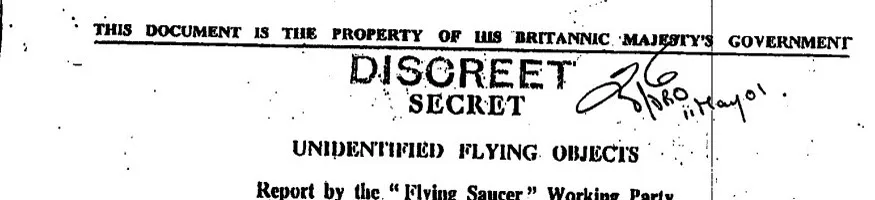
- Document: “Unidentified Flying Objects. Report by the ‘Flying Saucer’ Working Party”, DSI/JTIC Report No. 7
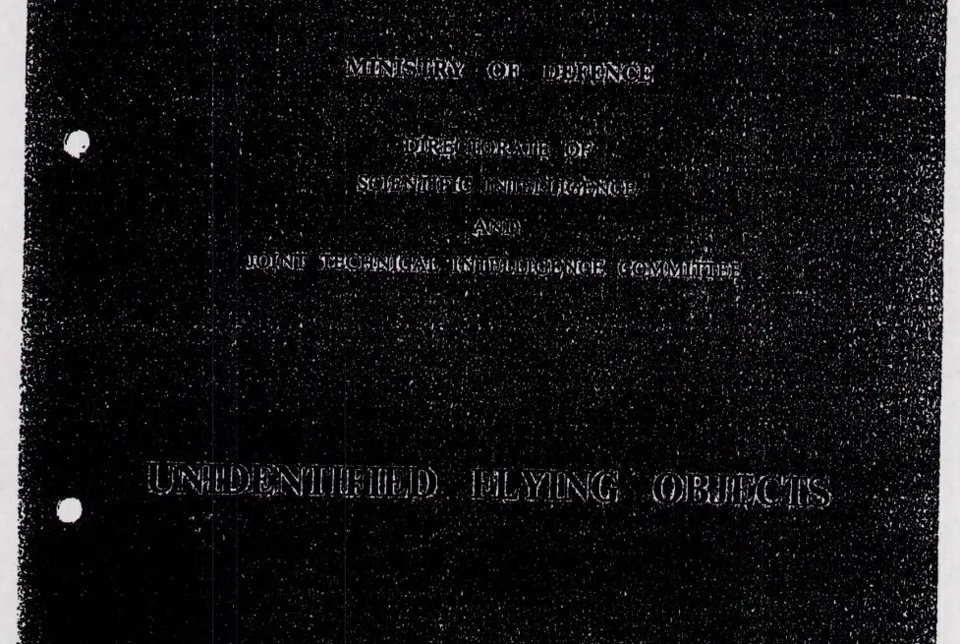
- Issued by: Ministry of Defence, Directorate of Scientific Intelligence and Joint Technical Intelligence Committee
- Date: June 1951, according to The National Archives
- Length / marking: a cover and five printed pages, including two appendices; marked “Secret” and “Discreet”
- Where it is today: The National Archives (UK), DEFE 44/119, with copies in DEFE 19/9 and DEFE 24/2050/1. Churchill’s 1952 minute is in PREM 11/855
Who wrote it, and why
According to The National Archives, the working party was set up in August 1950, after Sir Henry Tizard, Chief Scientific Adviser to the Ministry of Defence, argued that reports of flying saucers should not be dismissed without some investigation. Its terms of reference were to review the evidence, examine British reports and keep in touch with American work.
Its members were intelligence officers from the three armed services, chaired by G. L. Turney of the Admiralty. Circulation of the finished report was restricted, with one copy sent to Tizard.
What the working party looked at
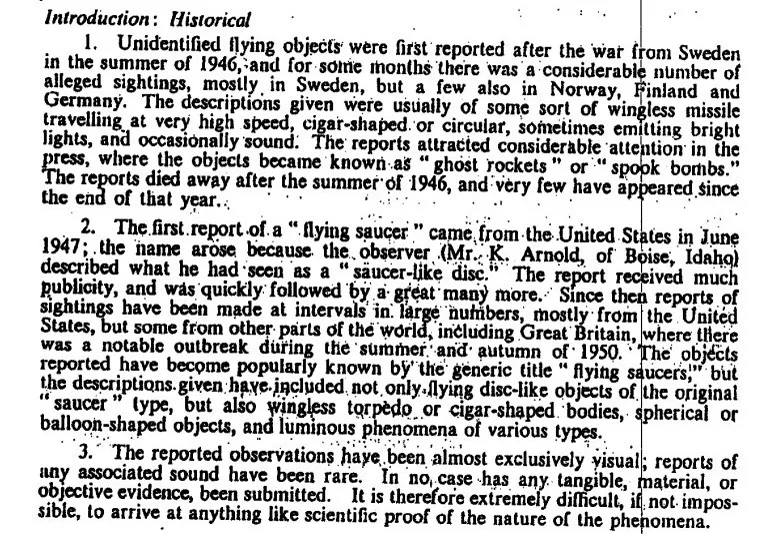
- The history: the Swedish “ghost rockets” of 1946 and the first American “flying saucer” report of June 1947.
- The American studies (Projects “Sign” and “Grudge”): the report repeats their conclusion that sightings were misidentifications, mass hysteria or hoaxes, and that a US pilot killed in 1948 had been pursuing the planet Venus.
- British press reports of 1950: it says plainly that it did not attempt a systematic investigation of all the evidence.
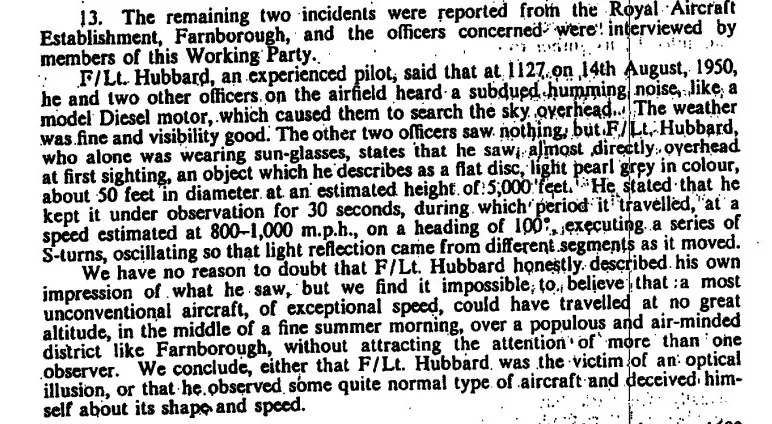
- Three official reports by experienced officers: a Meteor pilot over the Portsmouth area on 1 June 1950, and two sightings at Farnborough in August and September 1950.
“In no case has any tangible, material, or objective evidence, been submitted.”
The Farnborough sightings
At 11.27 on 14 August 1950 Flight Lieutenant Hubbard, an experienced pilot, reported a flat, pearl-grey disc about 50 feet across, moving at an estimated 800–1,000 mph. Two officers with him saw nothing. The working party did not doubt his honesty but concluded that he had suffered an optical illusion or misjudged a normal aircraft.
On 5 September 1950 he and five other officers saw a similar disc at 10–15 miles’ range. The verdict: a normal aircraft at extreme visual range, and an example of one report inducing another.
The conclusion
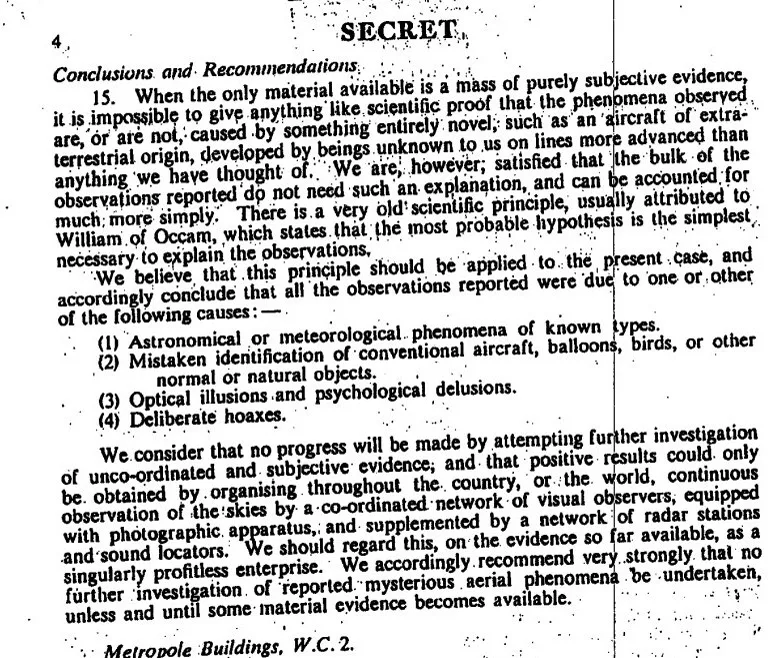
Paragraph 15 accepts that subjective reports cannot give scientific proof either way. Applying the principle attributed to William of Occam, it puts every observation down to known astronomical or meteorological phenomena, mistaken identification, optical illusions and psychological delusions, or hoaxes. A national network of observers, cameras and radar would, it says, be a profitless enterprise.
“We accordingly recommend very strongly that no further investigation of reported mysterious aerial phenomena be undertaken, unless and until some material evidence becomes available.”
Churchill asks, a year later
In July 1952 Washington radar reports made headlines. The National Archives’ guide quotes the Prime Minister’s minute of 28 July 1952 to the Secretary of State for Air:
“What does all this stuff about flying saucers amount to? What can it mean? What is the truth?”
According to the same guide, the reply of 9 August 1952 told him that the reports had been the subject of a full intelligence study in 1951, and that nothing since had changed the Air Staff’s opinion.
What it does not say
- It does not claim proof. The report states that scientific proof is impossible either way; it chooses the simplest explanation.
- It is not a full investigation. It examined three official cases in detail and says it did not study all the evidence.
- The blanked passage is unexplained. A deletion in paragraph 4, about the American reports, is stamped “Retained under Section 3(4)”; nothing shows what it contained.
- It was not written for Churchill. It dates from 1951; his question came in July 1952.
Why it matters
This short report set the line that British officials would follow for decades: listen, look for an ordinary cause, and spend nothing more without physical evidence. Its reasoning, and its admitted limits, are both on the page.
Sources
The National Archives (UK): the report as copied in DEFE 24/2050/1 (pages 34–39 of the file released online; original in DEFE 44/119), and The National Archives’ UFO briefing document for the account of the working party and of PREM 11/855. Images © Crown copyright; National Archives content is available under the Open Government Licence v3.0.
Comments (0)
Log in to comment