
1951 — The Lubbock Lights: professors, photographs and the Air Force's “birds”
In August 1951 four college professors in Lubbock, Texas, watched formations of lights cross the night sky, and a student photographed something similar days later. The Project Blue Book file holds the investigators' status report, the laboratory test of the negatives and the Air Force's final answer: probably migrating birds lit by street lights.
At a glance
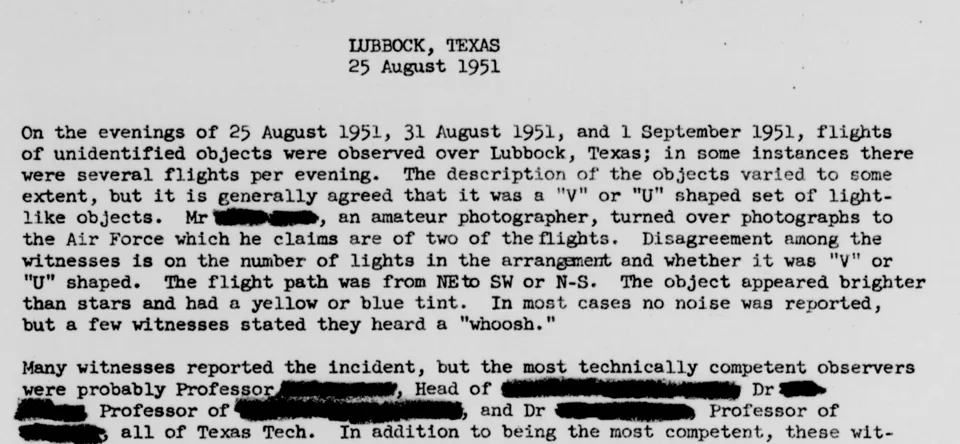
- Documents: Project Blue Book case file on Lubbock, Texas — a status report appendix (“Lubbock, Texas – 25 August 1951”), Test Report WCEFP-2-4 on the negatives (29 November 1951) and a later one-page case summary
- Issued by: US Air Force — Air Technical Intelligence Center and Wright Air Development Center
- Events: evenings of 25 August, 31 August and 1 September 1951
- Marking: formerly classified, now stamped unclassified; witness names blacked out
- Where it is today: US National Archives, Record Group 341, NAID 28939743
Four professors in a backyard
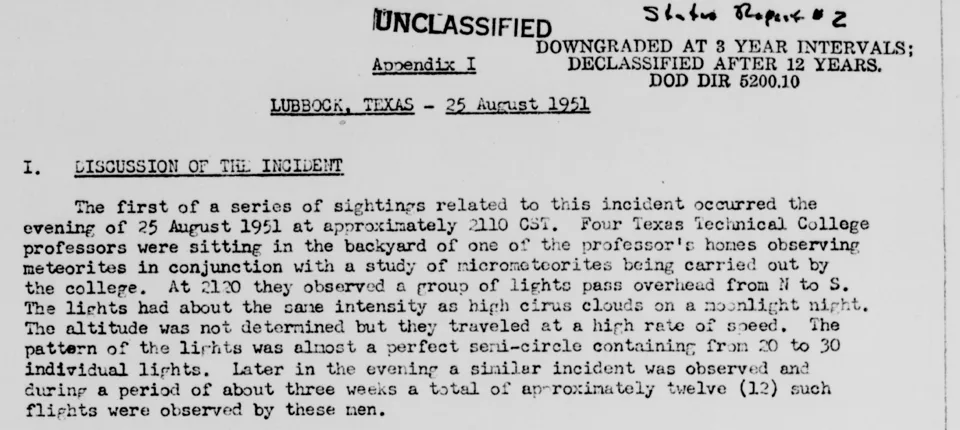
The status report sets the scene. On the evening of 25 August 1951 four Texas Technical College professors were sitting in a backyard watching for meteors when a group of lights passed overhead from north to south:
“The pattern of the lights was almost a perfect semi-circle containing from 20 to 30 individual lights.”
A similar flight followed later that evening. Over about three weeks the same men counted approximately twelve such flights.
What they measured — and could not
The professors treated it as a problem to be solved. Their observations, as listed by the Air Force:
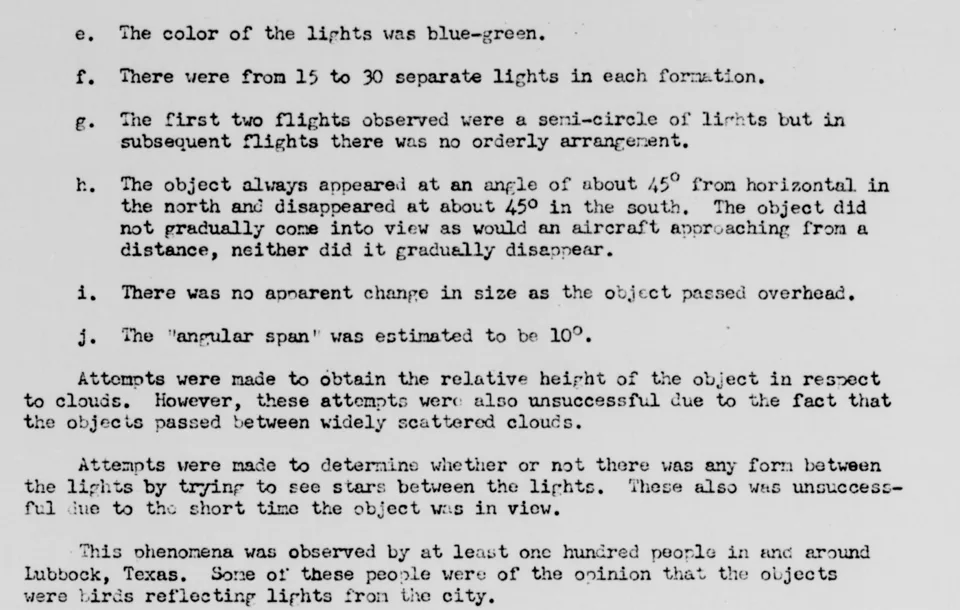
- angular velocity “very nearly 30° of arc per second”;
- no sound; path north to south, sometimes north-east to south-west;
- blue-green lights, 15 to 30 in each formation;
- the first two flights a semi-circle, later ones with “no orderly arrangement”.
They laid out a measured base line to find the altitude. Every attempt failed: the objects did not appear on the nights the observers were waiting. The report adds that at least one hundred people in and around Lubbock saw the phenomenon, and that some of them thought the objects were birds reflecting the city lights.
The photographs
On the evening of 31 August a Texas Tech freshman photographed two further flights from his backyard with a 35 mm camera. The Air Force received four negatives showing a V-shaped formation of lights.
Investigators questioned him and found “no obvious indications of a hoax”. The professors doubted the pictures showed what they had seen: they had never observed a V, and thought their lights too faint to photograph.
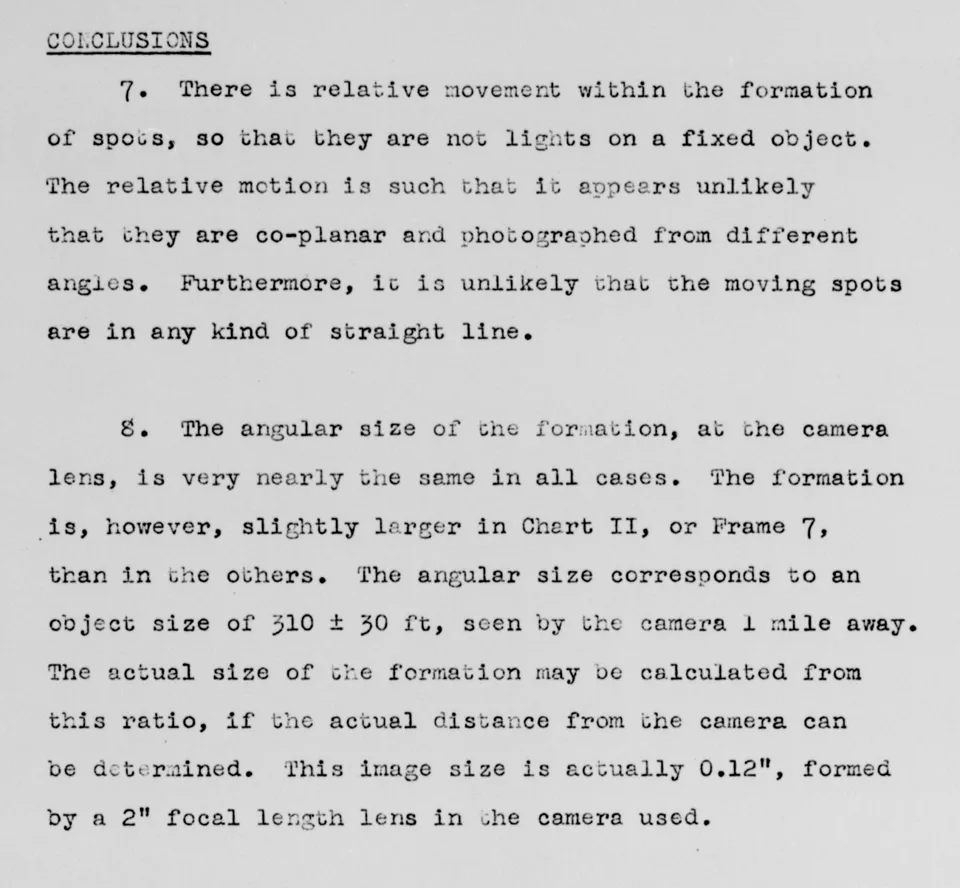
The Wright Air Development Center laboratory plotted the spots under a microscope. Roughly 20 appeared on each negative, in two rows on three of the four, and the spots moved relative to one another:
“There is relative movement within the formation of spots, so that they are not lights on a fixed object.”
The official conclusion
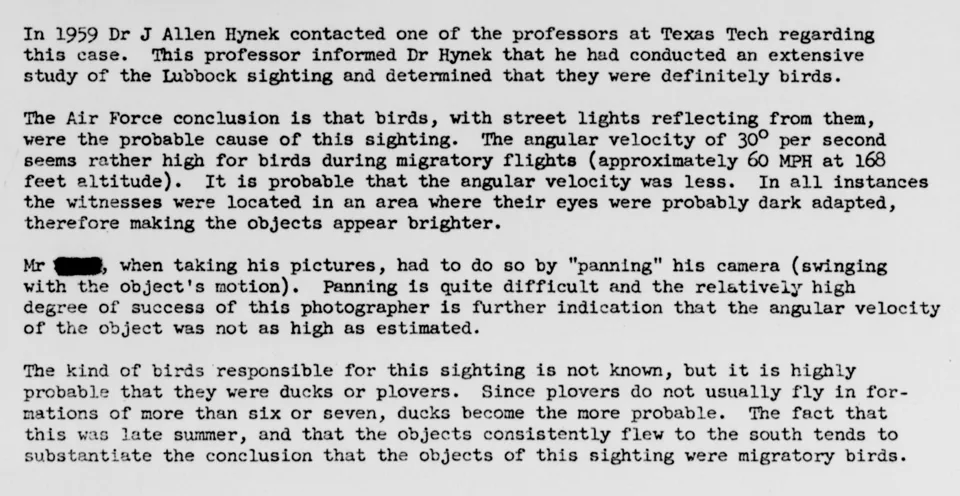
The status report left the question open. The professors did not believe the bird theory; a federal game warden doubted it but said it was possible. The later case summary, written in or after 1959, records that one of the professors had since told Dr J. Allen Hynek that the lights “were definitely birds”, and closes the case:
“The Air Force conclusion is that birds, with street lights reflecting from them, were the probable cause of this sighting.”
It names ducks as more probable than plovers, and concedes that 30° per second “seems rather high for birds”.
What it does not say
- It does not say the photographs were faked. The laboratory found the negatives were not retouched, and a re-interview found no indication that they were not authentic.
- It does not say the photographs show what the professors saw. The professors themselves doubted it.
- “Birds” is given as probable, not proven. The kind of bird “is not known”, and no altitude or true size was ever measured.
- The 310-foot figure is not a measured size. It holds only if the formation was one mile from the camera.
- The file disagrees with itself on one date: the test report puts the photographs on 30 August, the status report on 31 August.
Why it matters
Lubbock is a rare early case in which trained observers tried to measure what they saw, with protractors and stop-watches, and the Air Force sent the evidence to a laboratory. The file shows the limits of both: without a distance, neither the professors' angles nor the negatives could say how big or how fast the lights were.
Sources
US National Archives, Record Group 341, Project Blue Book case files, NAID 28939743 (the Lubbock papers are filed in the unit catalogued as “Orange, Va, September 1951”), unrestricted. US government work, public domain. The student's photographs are private work and are not reproduced here.
Comments (0)
Log in to comment