
1952 — Washington, D.C.: radar targets over the capital and the Pentagon's answer
On two July nights in 1952, unidentified targets filled the radar scopes at Washington National Airport and Andrews Air Force Base, and jet interceptors were sent up. The Air Force's own files hold the officers' report, the analysts' verdict and the minutes of the press conference that followed. They are more cautious than the legend.
At a glance
- Documents: a US Air Force intelligence report on the night of 26/27 July 1952; an Air Technical Intelligence Center memorandum of 29 August 1952; the Department of Defense minutes of the press conference of 29 July 1952; a Civil Aeronautics Administration technical report of May 1953
- Place: Washington National Airport and Andrews Air Force Base
- Dates of the sightings: nights of 19/20 and 26/27 July 1952
- Where they are today: US National Archives, Project Blue Book records (Record Group 341); the CAA report in the US Department of Transportation's online library
The second night, as reported
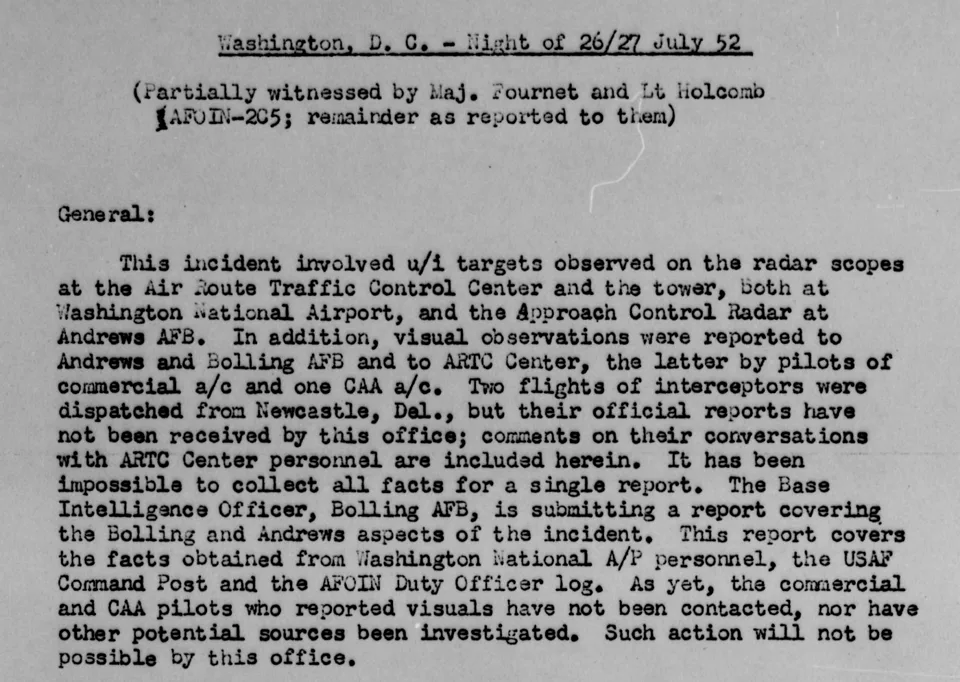
The fullest account in the file is a four-page report headed “Washington, D. C. – Night of 26/27 July 52”, partly witnessed by two officers from the Air Force's Directorate of Intelligence, Major Fournet and Navy Lieutenant Holcomb. It records:
- from about 9.50 p.m., “u/i” (unidentified) targets, up to 12 at once, on the Air Route Traffic Control Center radar at Washington National Airport;
- similar targets on the approach-control radar at Andrews;
- lights reported by airline pilots and by a Civil Aeronautics Administration (CAA) aircraft.
Jets, lights and a weather check
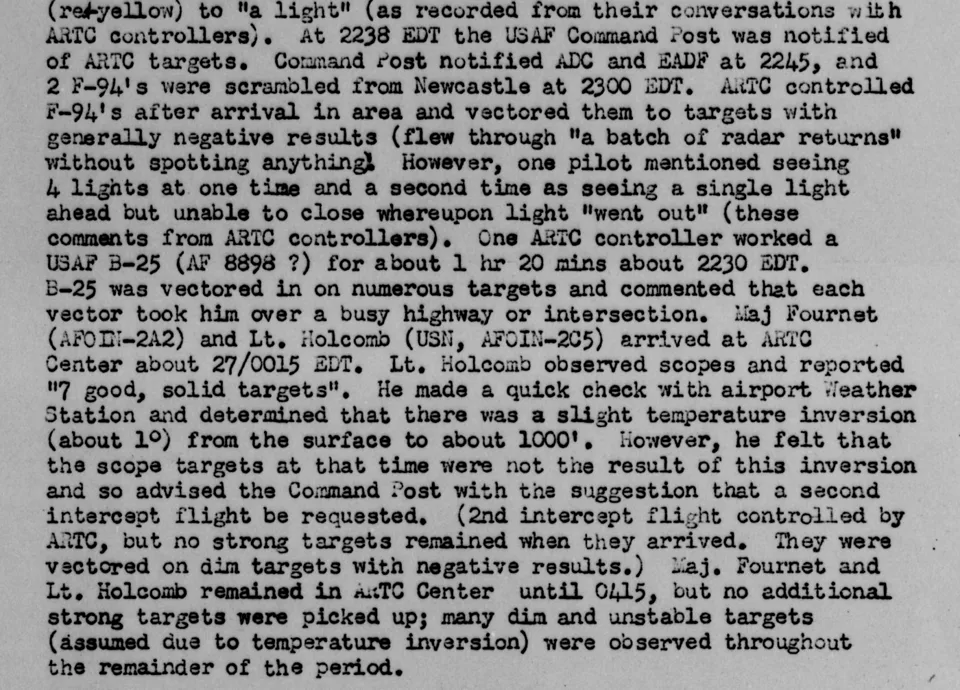
Two F-94 interceptors left Newcastle, Delaware, at 11 p.m. Guided towards the targets, they had “generally negative results”; one pilot mentioned seeing four lights, then a single light that “went out”. A B-25 crew guided to other targets remarked that each one lay over a busy highway or intersection.
Lieutenant Holcomb counted “7 good, solid targets” and checked the weather: a slight temperature inversion, about one degree, up to 1,000 feet.
“…he felt that the scope targets at that time were not the result of this inversion…”
A second flight found no strong targets left.
The Pentagon, 29 July
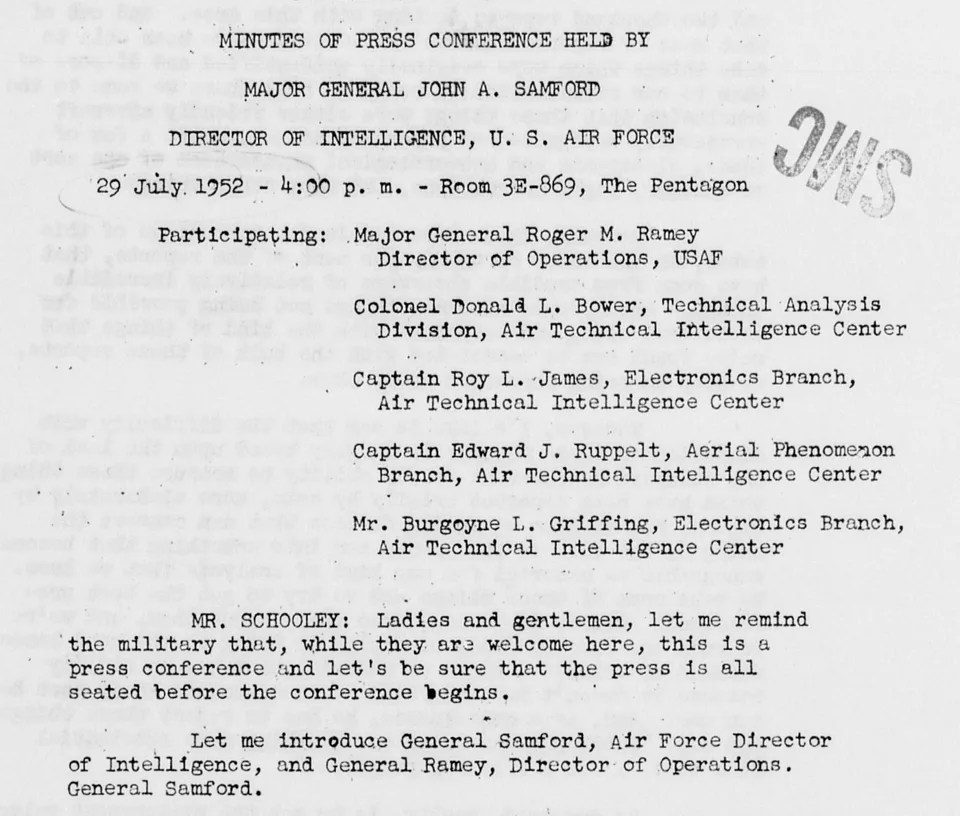
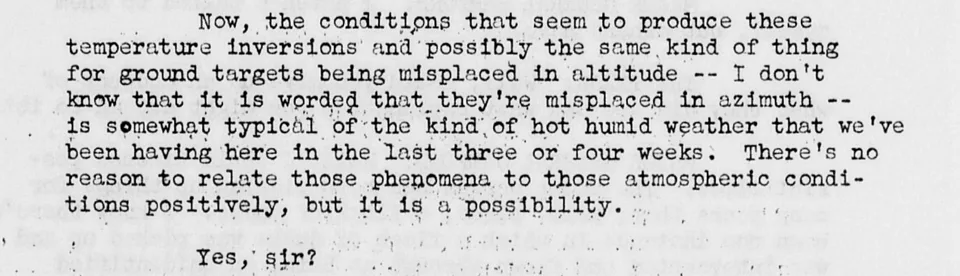
Three days later Major General John A. Samford, Director of Intelligence, met the press at 4 p.m. in Room 3E-869 of the Pentagon. The minutes show him saying that the Air Force had analysed between one and two thousand reports since 1947, and that about twenty per cent came from “credible observers of relatively incredible things”. He saw no pattern suggesting a menace to the United States. On the Washington radar he offered the weather as one candidate, no more:
“There's no reason to relate those phenomena to those atmospheric conditions positively, but it is a possibility.”
The analysts' verdict
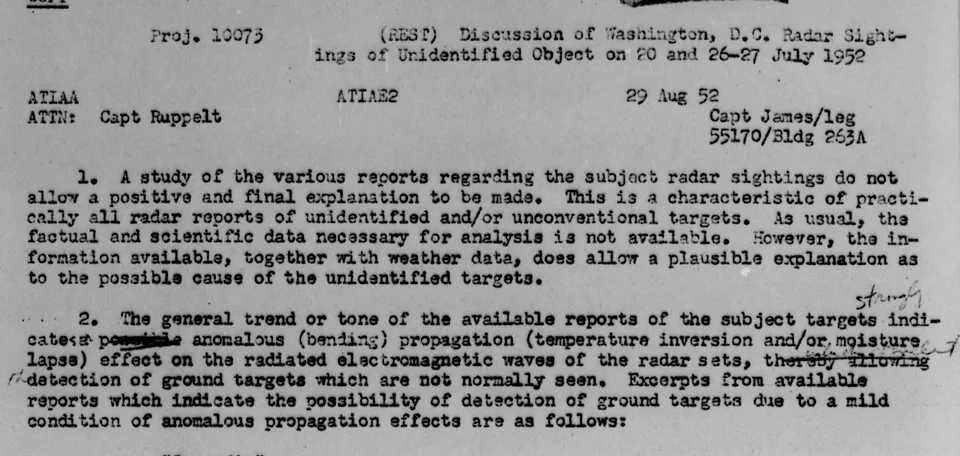
On 29 August 1952 the Electronics Branch of the Air Technical Intelligence Center addressed its conclusions to Captain Ruppelt, of the Center's Aerial Phenomenon Branch. They begin with a limit:
“A study of the various reports regarding the subject radar sightings do not allow a positive and final explanation to be made.”
The memorandum then gives what it calls a plausible explanation: slight temperature inversions bent the radar waves, so that ground objects not normally seen appeared on the scopes.
The civil study
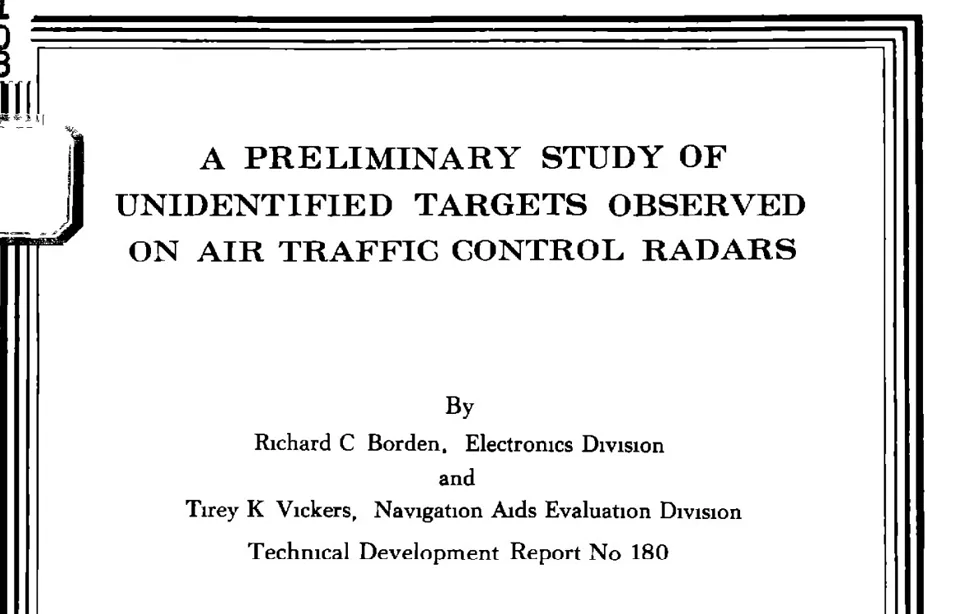
The CAA, which ran the airport's traffic-control radar, made its own study, published in May 1953. Its authors tracked and analysed the motion of 80 unidentified targets and found that a surface temperature inversion was almost always present when such targets appeared. A large number, they wrote, were secondary reflections of the radar beam; the targets were not new, and not peculiar to Washington.
What it does not say
- No document claims a proven explanation. The Air Force analysts wrote “plausible”, Samford said “possibility”, the CAA “it is believed”.
- The officer on the spot disagreed that night. Holcomb judged that the strong targets were not caused by the inversion; the report attributes only the later dim, unstable ones to it.
- The interceptors' radars found nothing. At the press conference General Ramey confirmed there had been no airborne radar sightings; the pilots reported lights.
- The CAA's first conclusion concerns its own observations of August 1952, not the July nights themselves.
- The report is incomplete by its own account: the pilots who saw lights had not been interviewed.
Why it matters
The Washington nights brought jet fighters over the capital and the Air Force's Director of Intelligence before the press. The papers show an institution reasoning in public and in private with the same words: possible, plausible, not proven.
Sources
US National Archives, Record Group 341: “Press Conference – Gen. Samford 1952” (NAID 461459117) and Project Blue Book case files, microfilm T1206 (NAID 28945857), both marked unrestricted. R. C. Borden and T. K. Vickers, “A Preliminary Study of Unidentified Targets Observed on Air Traffic Control Radars”, CAA Technical Development Report No. 180, May 1953 (National Transportation Library). US government works, public domain.
Read the press conference minutes at the US National Archives
Comments (0)
Log in to comment