
1956 — Lakenheath–Bentwaters: radar tracks over Suffolk
On the night of 13–14 August 1956, US Air Force radar operators at two English bases tracked targets they could not explain, and pilots were sent to look. Blue Book closed the case as anomalous radar propagation; its own consultant disagreed, and twelve years later the Condon study called it the most puzzling case in its radar-visual files.
At a glance
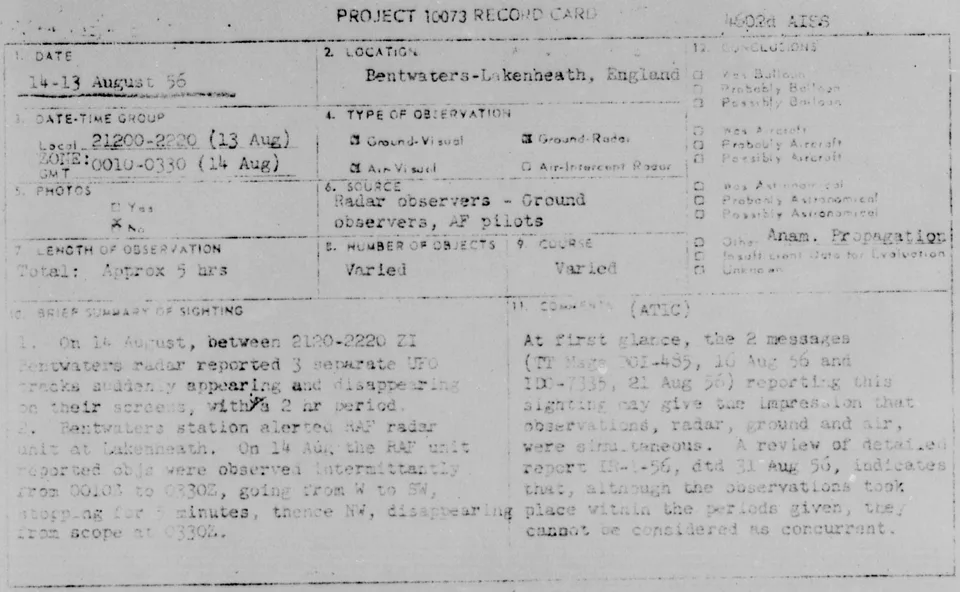
- Document: Project Blue Book case file “Bentwaters-Lakenheath, England, August 1956” (44 scanned pages)
- Key reports: report IR-1-56, 81st Fighter Bomber Wing, 31 August 1956; ATIC evaluation; memorandum by Dr J. Allen Hynek, 17 October 1956
- Event: 13–14 August 1956, RAF Bentwaters and RAF Lakenheath, Suffolk — British bases used by the US Air Force
- Blue Book verdict: anomalous propagation (“Anom. Propagation”)
- Where it is today: US National Archives, Record Group 341
What Bentwaters reported
The wing’s report, based on statements by US personnel, describes three sets of tracks on the Bentwaters ground-controlled approach (GCA) radar between 2120 and 2220 GMT on 13 August:
- a group of 12 to 15 targets moving north-east at an estimated 80–125 mph;
- a single target estimated at more than 4,000 mph;
- a third crossing east to west “at an exceptionally high speed”.
The operators did not think equipment malfunctions caused the returns. A control tower sergeant watched an amber light through 7×50 binoculars for about an hour. Two US fighter pilots searched for 45 minutes and found nothing.
Lakenheath, after midnight
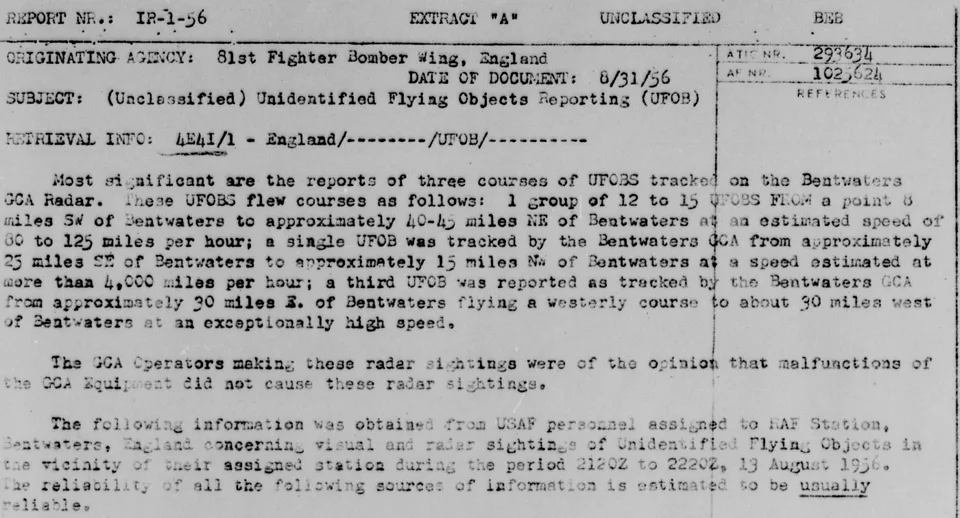
Bentwaters alerted the radar unit at Lakenheath. According to the Blue Book record card, objects were then observed intermittently from 0010 to 0330 GMT on 14 August, moving west to south-west, stopping for five minutes and then heading north-west before leaving the scope. The card puts the total duration at about five hours.
The Air Force verdict
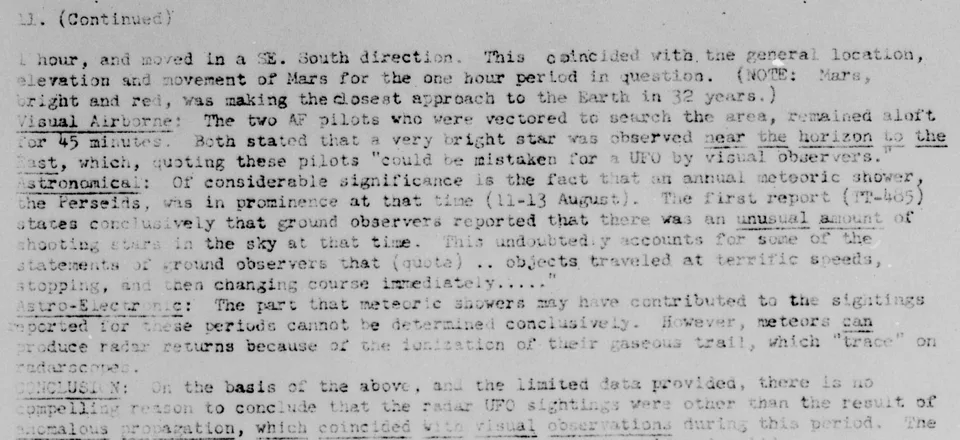
Analysts at the Air Technical Intelligence Center argued that radar, ground and air observations, although within the same periods, were not simultaneous. They matched the amber light to Mars, unusually close to Earth, noted the Perseid meteor shower, and concluded there was
“…no compelling reason to conclude that the radar UFO sightings were other than the result of anomalous propagation…”
The consultant disagreed
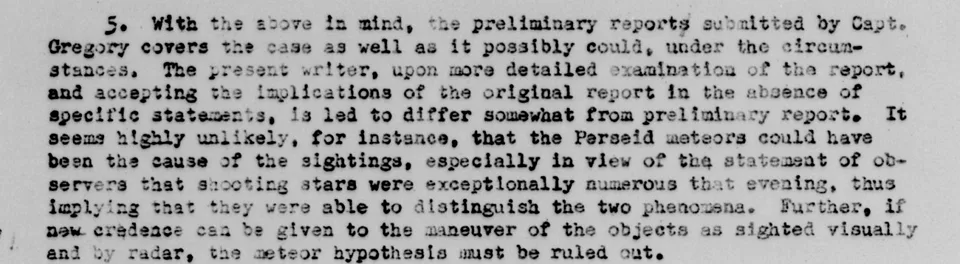
Blue Book’s astronomy consultant, J. Allen Hynek, reviewed the reports with the meteor expert Fred Whipple. He regretted the lack of detail but rejected the meteor idea: observers had remarked on numerous shooting stars, so they could tell the two apart. In the same memorandum he warned:
“The Lakenheath report could constitute a source of embarrassment to the Air Force…”
The Condon study, 1968
The University of Colorado study, carried out under an Air Force contract, received an unsolicited letter from a retired US controller who had been on duty at Lakenheath; it is also in the Blue Book file. In its radar chapter the study judged anomalous propagation unlikely and wrote: “this is the most puzzling and unusual case in the radar-visual files”, adding that more conventional explanations “cannot be entirely ruled out”.
On the British side, The National Archives notes that the Ministry of Defence destroyed UFO files every five years until 1967, so many records from before 1962 are lost.
What it does not say
- No RAF report of the night is in the file. The Lakenheath events, including the RAF interception often described, come from the record card summary and from the controller’s letter written more than a decade later.
- The Air Force did not leave it “unidentified”. The card is closed as anomalous propagation; Hynek’s objections did not change the verdict.
- There are no radar-scope photographs or gun-camera film in the file, and the report states that no physical evidence is available.
- Condon did not claim proof of anything exotic. It kept conventional explanations open.
Why it matters
Lakenheath is one of the few cases where Air Force analysts, their own scientific consultant and the later Air Force-funded study read the same thin evidence and reached different conclusions — all of it on paper that can now be read.
Sources
US National Archives, RG 341, Blue Book case file “Bentwaters-Lakenheath, England, August 1956” (NAID 28966873), microfilm T1206; US Air Force records, public domain. “Scientific Study of Unidentified Flying Objects” (Condon report), 1968, Vol. 1, pp. 245–246 and Section IV Case 2, pp. 372–387, Defense Technical Information Center AD 680975. The National Archives (UK), UFO research guide (2013), Open Government Licence.
Read the Lakenheath–Bentwaters file at the US National Archives
Comments (0)
Log in to comment