
1976 — Two jets over Tehran: the defence attaché’s report
In the early hours of 19 September 1976 the Imperial Iranian Air Force sent two F-4 Phantoms after a bright light north of Tehran. Four days later the US defence attaché cabled an account to Washington, and the Defense Intelligence Agency graded it. The National Security Agency later released the cable, the grading form and a US Air Force retelling. Here is what they say.
At a glance
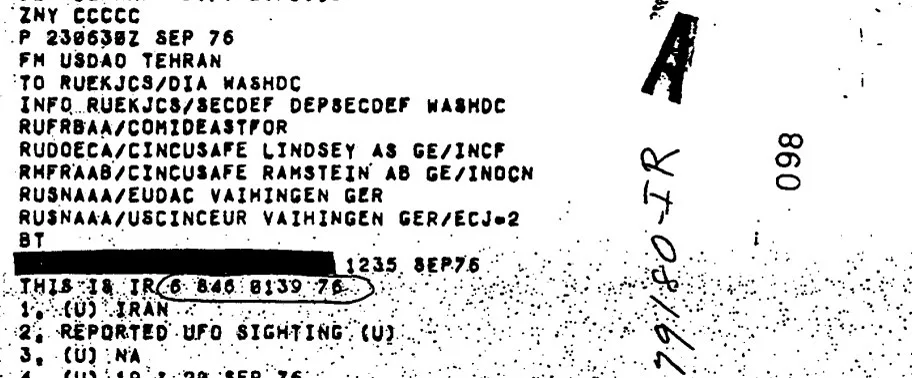
- Document: intelligence report IR 6 846 0139 76, “Reported UFO sighting”, with a DIA evaluation form and a DIA routing slip of 8 December 1978
- Issued by: US Defense Attaché Office (USDAO), Tehran — report signed by Col Frank B. McKenzie, USAF, Defense Attaché
- Date: message 230630Z September 1976; event 19 September 1976
- Sent to: the Defense Intelligence Agency; retransmitted by the Joint Chiefs of Staff to the White House, CIA, NSA and the services
- Where it is today: National Security Agency, “UFO Documents Index” (declassified documents)
The first F-4
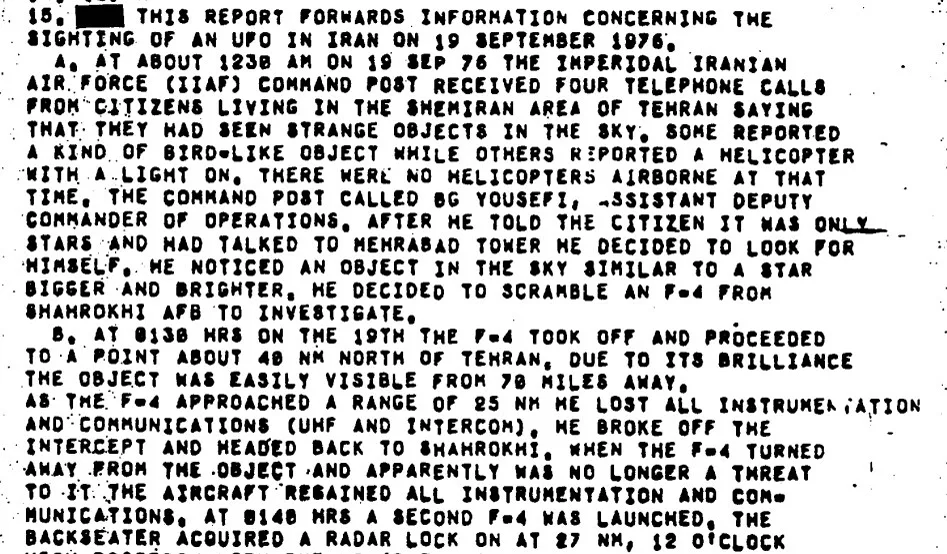
According to the report, around 12.30 a.m. the air force command post received four calls from residents of the Shemiran area of Tehran about strange objects in the sky. The brigadier general on call, the assistant deputy commander of operations, told a caller they were only stars, then looked for himself, saw something like a star but bigger and brighter, and scrambled an F-4 from Shahrokhi air base.
The jet saw the light from 70 miles away. At about 25 nautical miles it lost all instrumentation and communications; when it turned back, they returned.
The second F-4
A second Phantom took off at 0140 and its backseater locked on to the object by radar at 27 nautical miles. The report describes flashing strobe lights in a rectangular pattern, blue, green, red and orange. A smaller bright object then came out of it and headed for the jet:
“THE PILOT ATTEMPTED TO FIRE AN AIM-9 MISSILE AT THE OBJECT BUT AT THAT INSTANT HIS WEAPONS CONTROL PANEL WENT OFF AND HE LOST ALL COMMUNICATIONS…”
He dived away; the small object rejoined the larger one. Another seemed to drop to the ground and light up an area of 2–3 kilometres. Next day, by helicopter, the crew found nothing at the supposed spot — a dry lake bed — but picked up a beeper signal near a house whose occupants spoke of a loud noise and a very bright light. Radiation checks were said to be under way.
Where the information came from
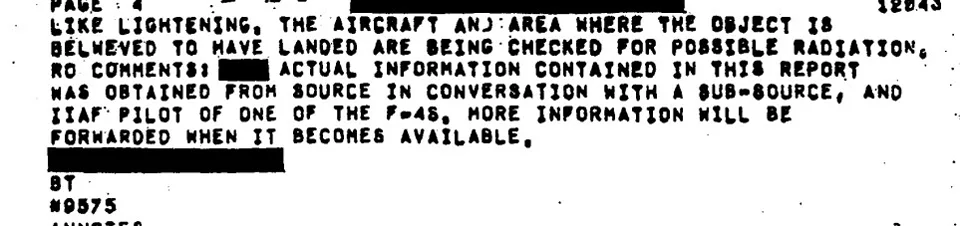
At the end of the cable the reporting officer added a comment on his sources:
“…ACTUAL INFORMATION CONTAINED IN THIS REPORT WAS OBTAINED FROM SOURCE IN CONVERSATION WITH A SUB-SOURCE, AND IIAF PILOT OF ONE OF THE F-4S.”
How DIA graded it
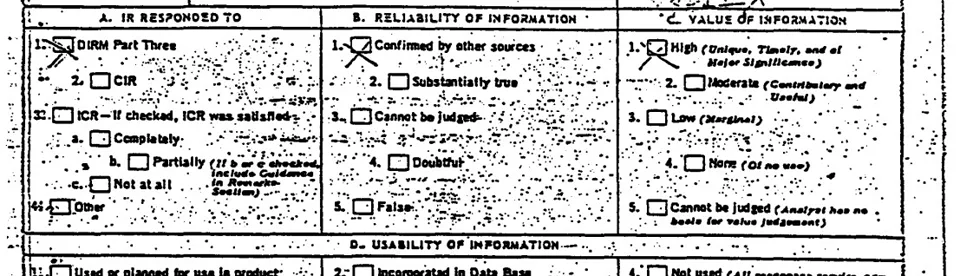
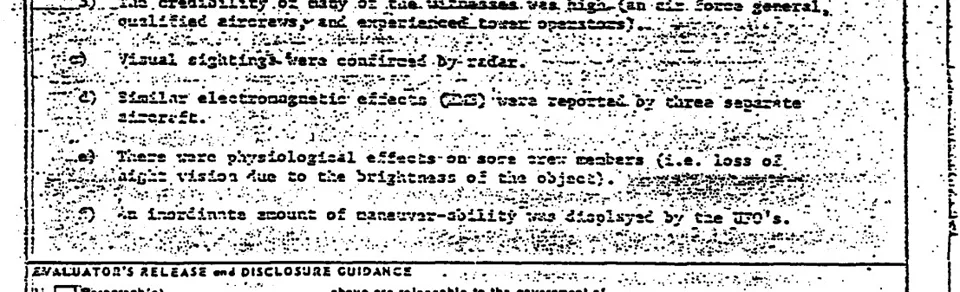
DIA’s evaluation form ticks reliability “Confirmed by other sources” and value “High (Unique, Timely, and of Major Significance)”, and marks the report as potentially useful. Its remarks list why the case was judged outstanding: credible witnesses (a general, aircrews, tower operators), electromagnetic effects reported by three aircraft, loss of night vision, and the objects’ unusual manoeuvrability. One line reads:
“Visual sightings were confirmed by radar.”
The Air Force retelling
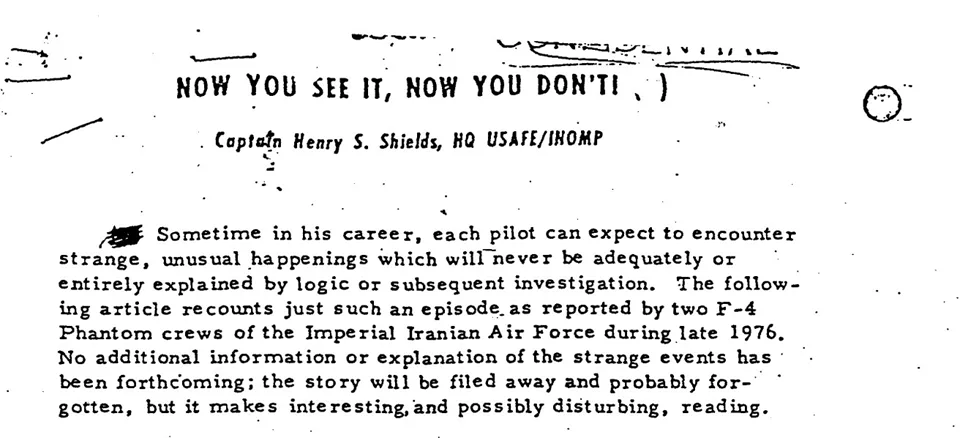
NSA also released “Now You See It, Now You Don’t!” by Captain Henry S. Shields, HQ USAFE, a classified article marked for declassification on 4 December 1981. It retells the same events for pilots, adds that no further information or explanation had come forward, and ends by noting that the results of the radiation tests had not been reported.
What it does not say
- It is not a first-hand report. The attaché passed on what a source learned from a sub-source and one of the pilots.
- It reaches no conclusion on what the object was. It promises more information; none is in the released file.
- DIA’s grading is about the report — its sources, timeliness and interest — not a finding that the object was a craft.
- No radiation results appear anywhere in these papers.
Why it matters
Few UFO reports travelled so far up the US chain: the cable went to the White House, the Secretary of Defense and the CIA. Read in full, it is a careful second-hand account — and the grading slip shows how an intelligence agency rated it, not what it believed.
Sources
National Security Agency, UFO Documents Index: “Routing and Transmittal Slip from Louis E. Foster, DIA with a DIA summary sheet and US Defense Attache report”; “Joint Chiefs of Staff report concerning the sighting of a UFO in Iran on 19 September 1976”; “Now You See It, Now You Don’t” by Capt Henry S. Shields. Works of the US Government, in the public domain.
Comments (0)
Log in to comment