

1986 — Brazil: five fighter jets and a CONFIDENTIAL Air Force report
On the night of 19 May 1986, lights and radar contacts over south-east Brazil led the Air Force to send up five interceptors. Two weeks later the air defence command wrote an eight-page report for the Minister. It is now public at Brazil's National Archives — with a conclusion rarely found in a military document.
At a glance
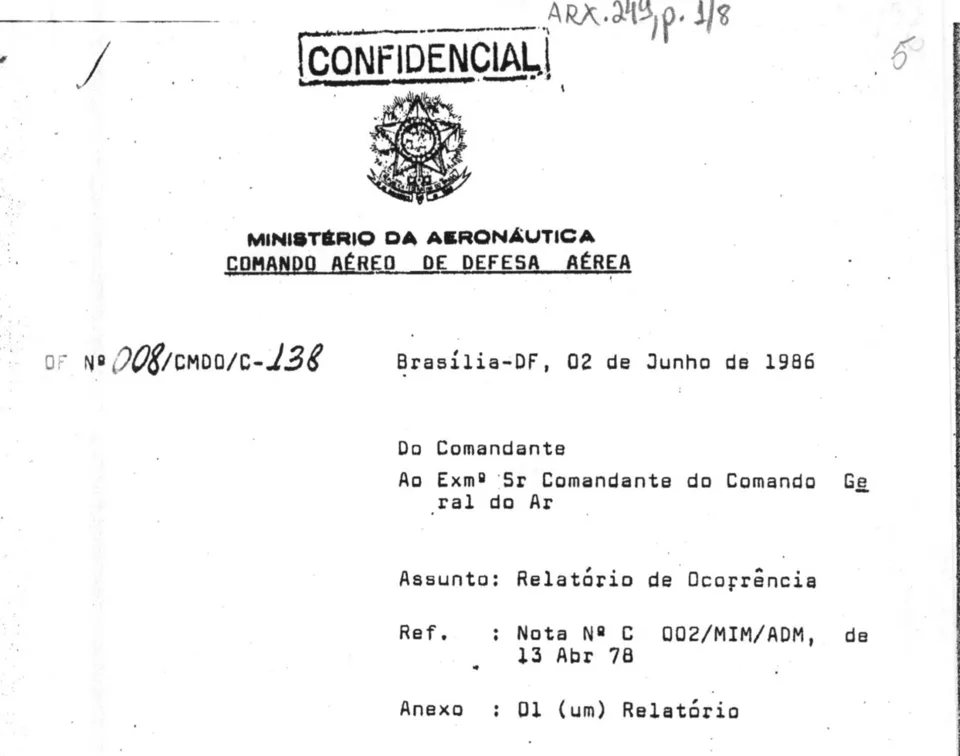
- Document: “Relatório de Ocorrência” (Occurrence Report)
- Issued by: Ministry of Aeronautics, Air Defence Command (Comando Aéreo de Defesa Aérea)
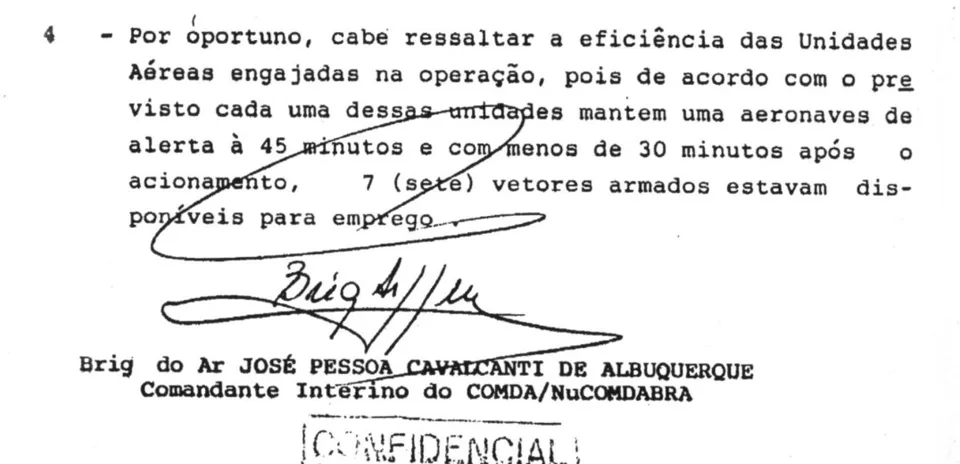
- Signed by: Brig. José Pessoa Cavalcanti de Albuquerque, acting commander
- Date: Brasília, 2 June 1986
- Length: 8 pages, stamped CONFIDENCIAL
- Where it is today: Arquivo Nacional (National Archives of Brazil), UFO collection, item BR DFANBSB ARX 249
What happened that night
According to the report, it began when the control tower at São José dos Campos saw coloured lights moving over the city and approach control in São Paulo confirmed radar contacts. Over the following hours the Air Force sent up five interceptors: two from Santa Cruz Air Base and three from Anápolis.
- One pilot followed a white light, held it on his aircraft's radar, and turned back over the sea when fuel ran low.
- Another had radar contact only, with nothing to see.
- Two of the five aircraft had no contact of any kind.
The report says it limits itself to a plain account of the facts, to avoid feeding speculation.
What the command noted
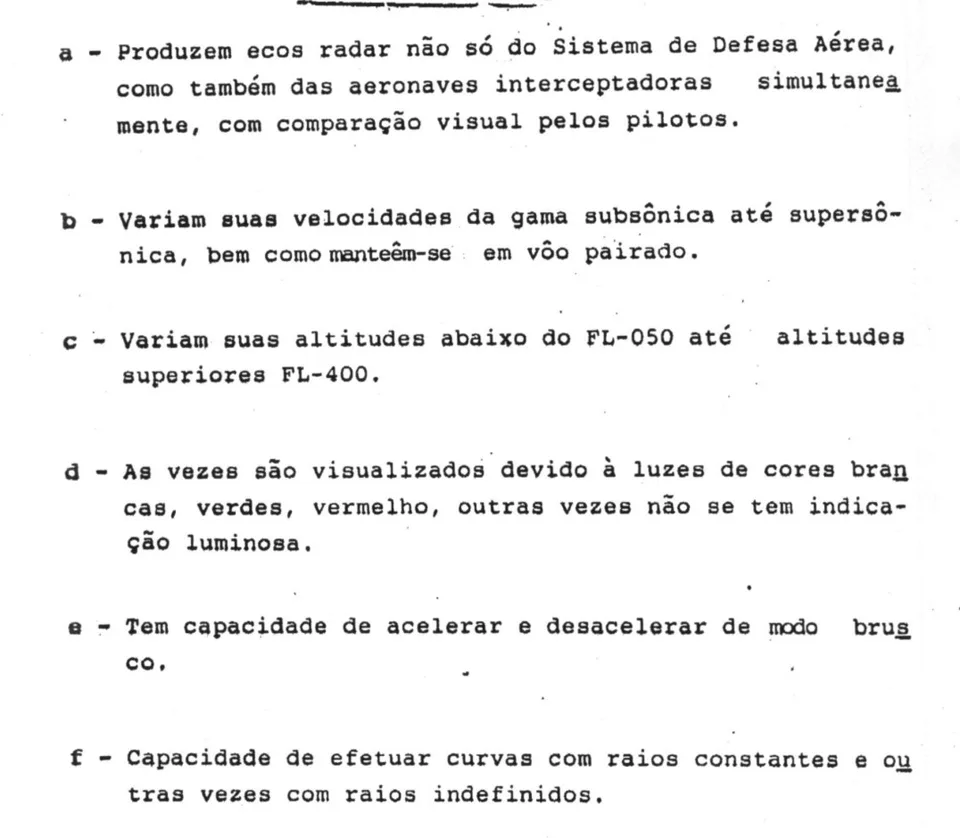
The last page lists the features the reports had in common. The phenomena:
- produced radar echoes on the air defence system and on the interceptors at the same time, matched by what pilots saw;
- varied in speed from subsonic to supersonic, and also hovered;
- ranged in altitude from below 5,000 feet to above 40,000;
- were sometimes visible as white, green or red lights, sometimes not visible at all;
- accelerated and slowed abruptly.
The conclusion
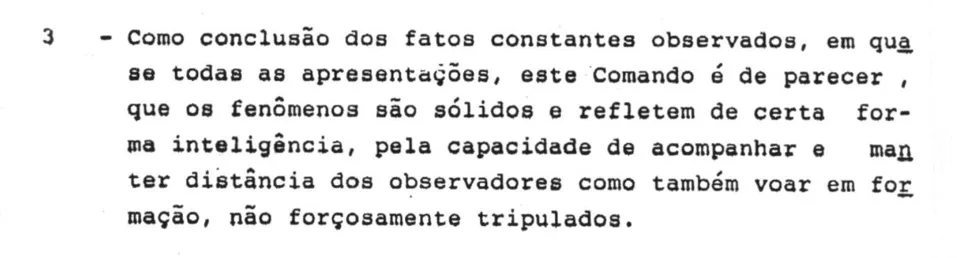
Then comes paragraph 3, the sentence that made the document famous:
“…este Comando é de parecer que os fenômenos são sólidos e refletem de certa forma inteligência, pela capacidade de acompanhar e manter distância dos observadores como também voar em formação, não forçosamente tripulados.”
In English: this Command is of the opinion that the phenomena are solid and reflect, in a certain way, intelligence, by their capacity to follow and keep distance from the observers as well as to fly in formation, not necessarily manned.
The Minister spoke in public
The episode was never hidden. Four days later, on 23 May 1986, the Minister of Aeronautics held a press conference. Brazil's government portal quotes him: “Technically, I would tell you that we have no explanation.” The same official account speaks of 21 objects over four states.
The written report stayed confidential until it was released in 2009. The Air Force has since transferred most of its UFO records to the Arquivo Nacional.
What it does not say
- It does not say “extraterrestrial” and names no origin at all.
- It is an opinion (“é de parecer”) of an operational command, not a scientific finding.
- The figure of 21 objects is not in the report. It comes from the Minister's press conference.
- The report itself notes a limit: the radar network was built mainly for air traffic control, not for air defence.
- “Night of the UFOs” is the popular name; the document is simply an occurrence report.
Why it matters
It is one of the few cases in which an air force scrambled fighters, briefed the press within days and later opened the paperwork. Brazil's National Archives adds its own sober reminder: UFO does not necessarily mean flying saucers or extraterrestrials — it means unidentified.
Sources
Arquivo Nacional (Brazil), Fundo “Objeto Voador Não Identificado”, BR DFANBSB ARX, item 249. Government of Brazil, “Official UFO Night in Brazil”, 20 May 2022.
Comments (0)
Log in to comment