
1986 — Japan Air Lines flight 1628 over Alaska: the FAA file
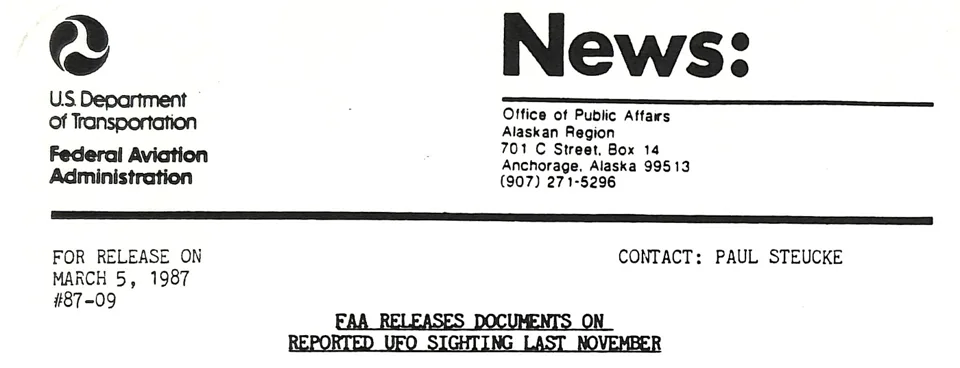
A Japanese cargo 747 crew reported unidentified traffic beside them for over half an hour above Alaska. The Federal Aviation Administration investigated as air-traffic controller, not as UFO investigator, and released its whole file in March 1987. The papers, now at the US National Archives, show what the crew reported, what the radar showed and why the FAA closed the case.
At a glance
- Documents: the FAA Alaskan Region’s release package on Japan Air Lines flight 1628 — incident record (FAA Form 8020-5), interview notes, radar explanation and news releases
- Issued by: Federal Aviation Administration, Alaskan Region, Anchorage (public affairs officer Paul Steucke)
- Event: evening of 17 November 1986 (local time), between the Canadian border and Anchorage
- Released: 5 March 1987
- Where it is today: US National Archives at Seattle, Records of the Federal Aviation Administration (RG 237), series “Information Releases Relating to Unidentified Flying Object” (NAID 733667)
What the incident record says
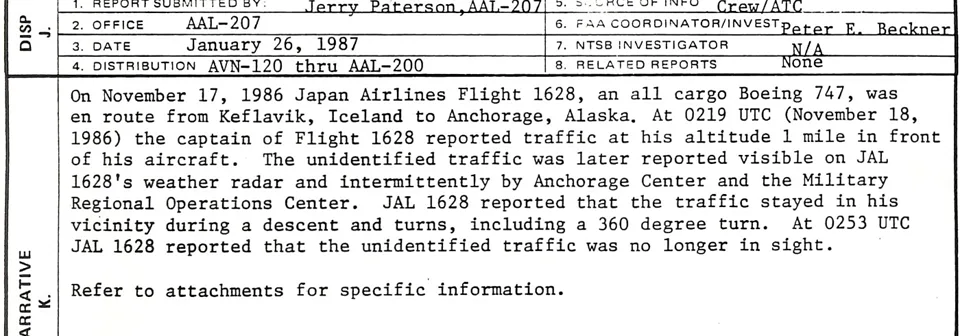
The FAA’s own summary, dated 26 January 1987, is short. JAL 1628, an all-cargo Boeing 747 flying from Keflavik, Iceland, to Anchorage:
- at 0219 UTC (18 November) the captain reported traffic at his altitude, one mile ahead;
- the traffic was later reported on the 747’s weather radar and, intermittently, by Anchorage Center and the Military Regional Operations Center;
- it stayed near the aircraft through a descent and turns, including a 360-degree turn;
- at 0253 UTC the crew reported it was no longer in sight.
The three crew members were Captain Kenju Terauchi, First Officer Takanori Tamefuji and Flight Engineer Yoshio Tsukuba.
The crew interview
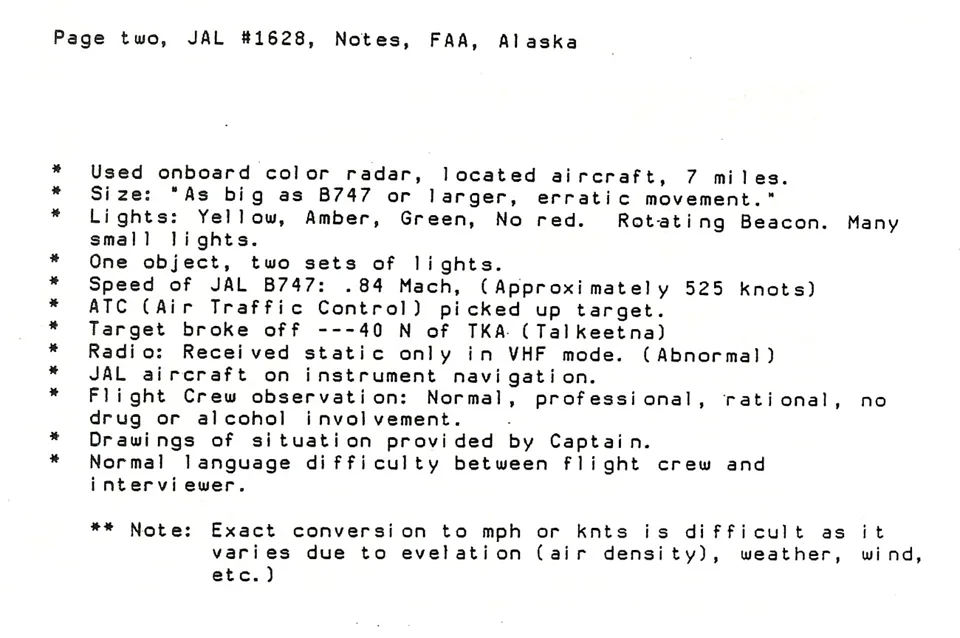
That night FAA security and flight-standards staff interviewed the crew at Anchorage. The typed notes, released by the FAA, record the captain’s description in fragments: onboard colour radar showing the traffic at 7 miles; yellow, amber and green lights, no red; one object with two sets of lights. They also record the size the crew gave:
“As big as B747 or larger, erratic movement.”
The interviewers assessed the crew as “Normal, professional, rational, no drug or alcohol involvement”, and noted the usual language difficulty between crew and interviewer.
What the radar showed
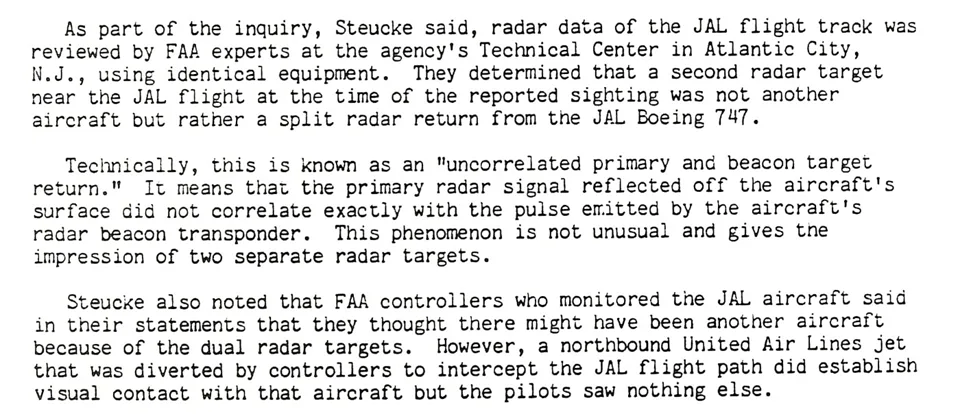
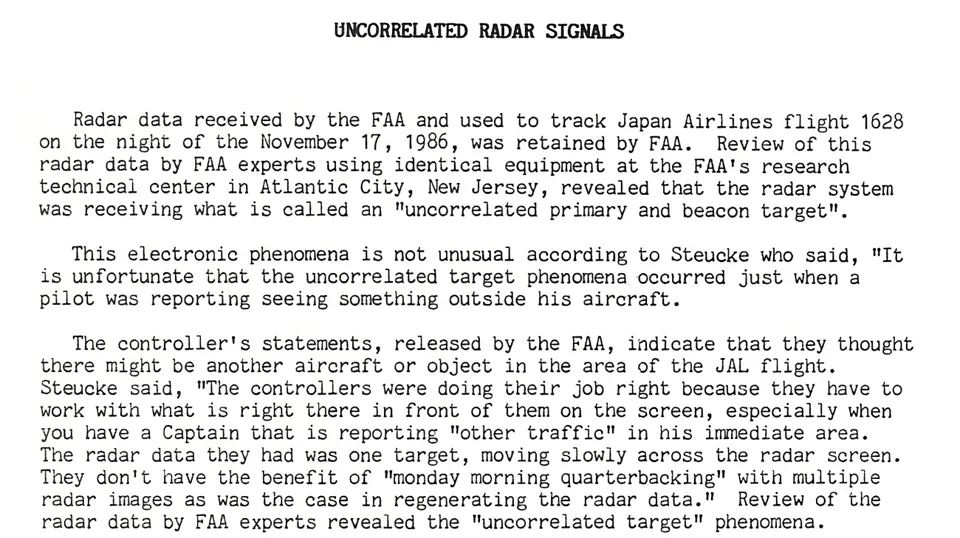
Because controllers had seen a second target, the FAA had its recorded radar data replayed at its Technical Center in Atlantic City on identical equipment. The finding, announced on 5 March 1987: the second return …
“…was not another aircraft but rather a split radar return from the JAL Boeing 747.”
In FAA terms, an “uncorrelated primary and beacon target”: the radar echo from the aircraft’s skin and the reply from its transponder did not line up exactly, which looks like two targets. A northbound United Air Lines jet was diverted to the JAL flight path; its pilots saw the JAL aircraft and nothing else.
The FAA’s conclusion
The news release says the FAA was unable to confirm the event, that it had pursued the report only as operator of the air traffic control system, and that it was satisfied the safety of that system had not been compromised. A separate statement of the same day set the limits plainly: “The FAA does not have the resources or the Congressional mandate to investigate sightings of unidentified flying objects.”
What it does not say
- It does not say the crew invented anything. The interview notes describe them as normal and professional; the FAA simply did not try to determine what they saw.
- It does not say radar confirmed a second craft. Controllers thought there might be one; the FAA’s replay attributed the second target to a split return from the 747 itself.
- It does not explain the lights. The FAA states it made no analysis of stars, planets or angles of view.
- “UFO” is the FAA’s headline word for the press; the incident record speaks of “unidentified traffic”.
Why it matters
This is one of the few cases where an aviation authority released its working file — forms, interview notes, recordings and radar explanations — less than four months later. It lets anyone separate what a crew reported, what a machine recorded and what an agency was prepared to conclude.
Sources
US National Archives at Seattle, Records of the Federal Aviation Administration (RG 237), series “Information Releases Relating to Unidentified Flying Object” (NAID 733667): file units 40586906 (FAA Form 8020-5), 40587486 (FAA news releases, including the crew-interview notes) and 40587480 (split beacon target). Works of the US Federal Aviation Administration, in the public domain; the file units are marked “Unrestricted” by NARA.
Comments (0)
Log in to comment