
2020 — The Pentagon releases three Navy videos: FLIR, GIMBAL, GOFAST
On 27 April 2020 the US Department of Defense officially published three short infrared videos filmed by Navy pilots in 2004 and 2015. Watch the original files here, with the exact words the Pentagon used — and the later NASA analysis of one of them.
At a glance
- Document: “Statement by the Department of Defense on the Release of Historical Navy Videos”
- Date: 27 April 2020
- What was released: three unclassified videos — one from November 2004, two from January 2015
- Where they are: Naval Air Systems Command (NAVAIR), FOIA reading room, files “1 - FLIR”, “2 - GIMBAL”, “3 - GOFAST”
Why the Pentagon published them
The clips were not new. They had been circulating since unauthorised releases in 2007 and 2017, and the Navy had already confirmed they were genuine Navy footage. The statement gives one reason for the official release:
“…to clear up any misconceptions by the public on whether or not the footage that has been circulating was real…”
A review had found that the videos reveal no sensitive capabilities or systems.
1 — FLIR (November 2004)
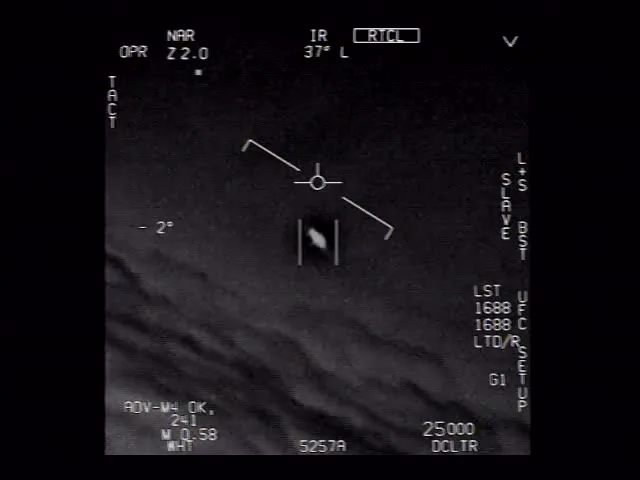
The oldest of the three: black-and-white infrared footage from a Navy fighter's targeting pod. The camera holds a small object in the centre of the frame until it slides out of view to the left.
2 — GIMBAL (January 2015)
The best known. The crew can be heard reacting as the shape on the display appears to rotate. The numbers around the edge are the sensor's own data: viewing angle, aircraft speed and altitude.
3 — GOFAST (January 2015)
A small object seems to race low over the sea. It is the clip that has since been examined most closely in an official publication.
What NASA later worked out about GOFAST
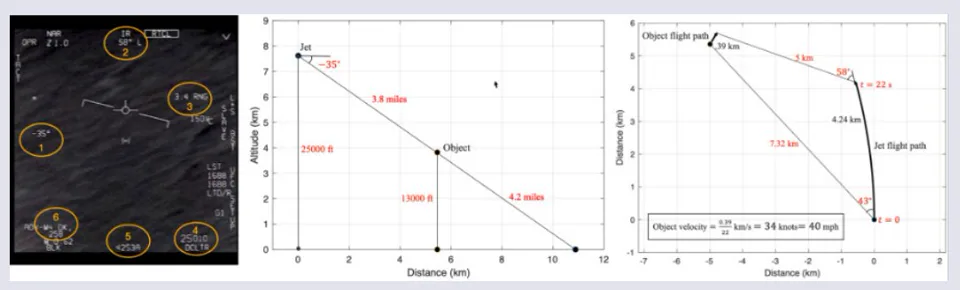
In its 2023 report, NASA's independent study team used the figures visible on the screen — camera angle, range, aircraft altitude and speed — and some trigonometry. The result:
- the object was at about 13,000 feet, not skimming the water;
- it moved about 390 metres in 22 seconds: roughly 40 mph, a typical wind speed at that height;
- it shows no heat from propulsion.
The impression of great speed comes largely from the jet's own motion — the parallax effect. NASA's conclusion: the object was “most likely drifting with the wind”.
What the statement does not say
- It does not say what the objects are. The only word it uses is “unidentified”.
- It does not mention extraterrestrials, craft or any extraordinary performance.
- It was not a declassification. The videos are described as already unclassified.
- It names no ships, pilots or places.
“The aerial phenomena observed in the videos remain characterized as ‘unidentified.’”
Why it matters
For the first time a defence ministry published such footage itself, under its own name. It moved the subject from leaks and rumours to official records — and, three years later, allowed scientists to show how much can be learned simply by reading the numbers on the screen.
Sources
US Department of Defense, statement of 27 April 2020. Naval Air Systems Command, FOIA reading room. NASA, UAP Independent Study Team Report, September 2023. US government works, public domain.
Comments (0)
Log in to comment