

2021 — US intelligence reports to Congress: 144 cases, one explained
Nine unclassified pages from the Office of the Director of National Intelligence: the first public assessment of “unidentified aerial phenomena” by the US intelligence community. The key numbers, the five possible explanations, and the sentences that are most often misquoted.
At a glance
- Document: “Preliminary Assessment: Unidentified Aerial Phenomena”
- Issued by: Office of the Director of National Intelligence (ODNI), drafted with the Navy-led UAP Task Force
- Date: 25 June 2021
- Length: 9 pages, UNCLASSIFIED
- Written for: the US Congress, which had asked for it
The numbers
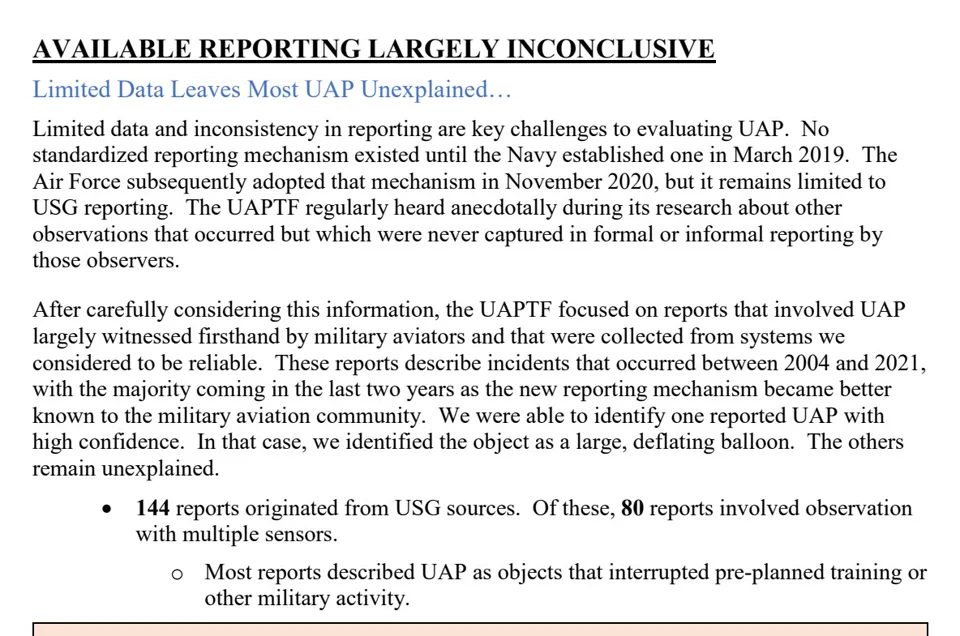
- 144 reports from US government sources, covering 2004 to 2021 — most from the last two years.
- 80 of them involved observation by several sensors at once.
- 1 was identified with high confidence: a large, deflating balloon.
- 143 remained unexplained.
- 18 incidents (21 reports) showed unusual movement or flight characteristics.
- 11 documented near misses with aircraft.
The opening sentence sets the limits
“The limited amount of high-quality reporting on unidentified aerial phenomena (UAP) hampers our ability to draw firm conclusions about the nature or intent of UAP.”
Most cases stayed unexplained for lack of data, not because they were shown to be extraordinary. Until the Navy introduced one in March 2019 there was not even a standard way to report a sighting.
Five possible explanations
The report expects that, with better data, cases will fall into one of five groups:
- Airborne clutter — birds, balloons, recreational drones, debris.
- Natural atmospheric phenomena — ice crystals, moisture, thermal effects.
- US government or industry programmes.
- Foreign adversary systems.
- “Other” — a holding category for whatever needs more scientific knowledge to understand.
The 18 unusual incidents
In these cases observers described objects that appeared to stay still in high winds, move against the wind, manoeuvre abruptly or travel at considerable speed with no visible means of propulsion.
The report immediately adds a caution: such observations could be the result of sensor errors, spoofing or observer misperception, and need rigorous analysis.
What it does not say
- The words “extraterrestrial” and “alien” do not appear. The report neither claims nor rules out any origin.
- It does not say 143 objects showed advanced technology. Only 18 incidents involved unusual behaviour, with the caution quoted above.
- It does not confirm foreign technology: it says there are no data showing that any UAP belongs to a foreign collection programme.
- It says most UAP “probably do represent physical objects” — probably, and most, not all.
Why it matters
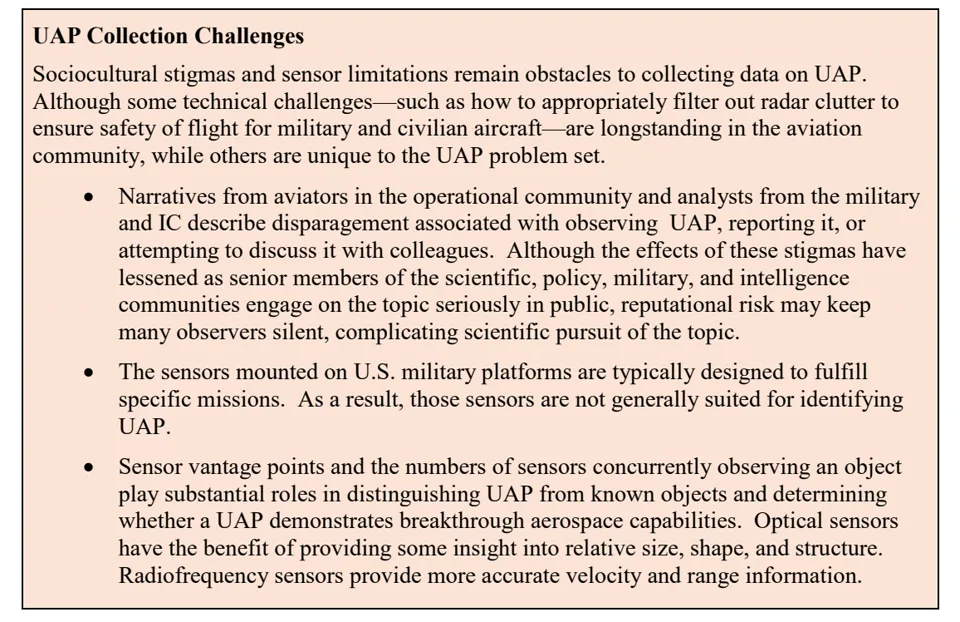
It treats the subject as a practical problem: flight safety first, possible national-security concern second. And it names the two real obstacles to an answer — poor data and the stigma that keeps pilots from reporting. Everything that followed in the United States, from yearly reports to a dedicated office, starts here.
Source
Office of the Director of National Intelligence, “Preliminary Assessment: Unidentified Aerial Phenomena”, 25 June 2021. US government work, public domain.
Comments (0)
Log in to comment